Chapter-11
The Senior Management Development Programme course in the United Kingdom (September 1984 to December 1984)
The nomination and the preparatory works: -
I was Addl. Divisional Railway Manager at Danapur during March'84 when I first knew of my nomination for British Council Fellowship. After filling of nomination form in the Railway Board office there was a long period of wait during which I obtained the official passport (white colour) from the passport office at Patna on the authority of a courtesy letter from the DRM. The passport bore an endorsement that it was not valid for Portugal. Visa was not required for U.K. The other formalities to be complied were submitting medical report by the Medical Superintendent, E.Rly. Danapur and obtaining courtesy letter from the E.Rly.Hqrs. for availing concessional rail travel facility in the continent.
Pre-Derby course-I had to undergo this course for a week at the Railway Staff College, Vadodra. One of the participants to this course was my batchmate. But what pleased me was the presence of Mihir Kumar Dev Verma (Dy.CE/N.F.Rly) who while introducing himself reminded me that he was a probationer under me when I was DEN/Danapur 10 years back. Those having attended the Sr. Management Development Programme in the past, shared their experience with us. Inter alia the following tips were given to us:
Carry photocopy of all the important documents.
Carry at least half a dozen passport size photographs.
Carry items of gifts (cigars, sandalwood, handicrafts, etc.) for presentation to the school staff & visiting speakers at Derby. They like it.
Always wear a coat or parka and keep passport & cash in the inside pocket. Be ready to face the ruffians at Paris. They will suddenly confront you; thrust a newspaper in front of your eye asking you to read it. By the time you realize what is what you are relieved of your passport and purse. Deal them without getting scared.
Three months is a long period and in between a haircut (a costly affair) cannot be avoided. A specially designed haircutting device (combining the functions of comb and scissors) was demonstrated to us with the advice that one such appliance will suffice for the batch.
Distance yourself from the punks.
Don’t purchase shirts & pants as their design does not suit us. On the other hand, coats, gowns, cardigans, pullovers & frocks which are of superior quality and economically priced merit purchase. Carry minimum items of clothing leaving enough room in the suitcase for freshly acquired dress materials.
Apart from Paris and Brussels other interesting places are Innsbruck (a must-see Alpine destination in Austria) and Maduro dam (the miniature Dutch city at Hague built to a scale of 1:25). For visiting the latter ferry services between Harwich in England and Hook of Holland in Netherlands exists.
Danapur to Delhi (09.09.1984)--There was a period of suspense as more persons had attended the PreDerby course than the number allotted for the training in U.K. The anxiety was over once I received the final call letter. Everybody in the family was happy at the news. Younger brother who had visited France some 15 years back gave me some tips.
Ultimately the long looked for moment came. It was on 09.09.1984 the family members, close relatives and well-wishers had assembled in the Railway bungalow (No-44DEF) at Danapur to shower blessings, best wishes and parting dos and don’ts in my mission to the United Kingdom which, according to old saying, lay beyond the seven seas.
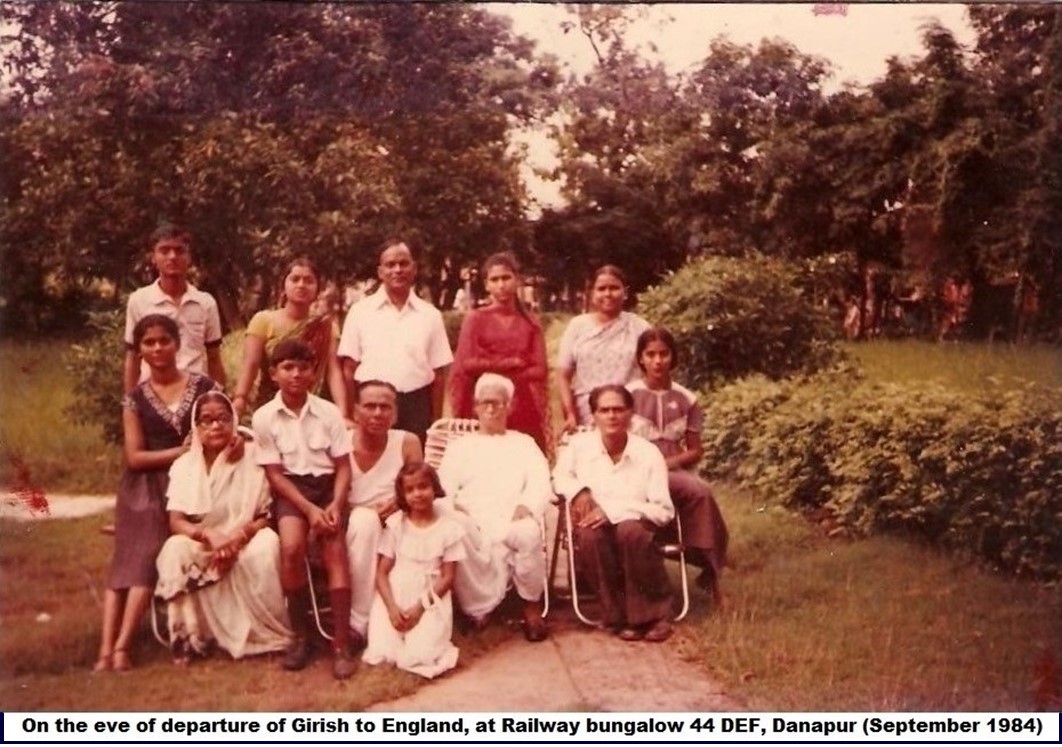
Group photography, sharing of sweets, obeisance to deities, application of 'tilak' on the forehead and garlanding were the rituals I had to undergo on this occasion. Sadly my Mother who had blessed me with the coveted railway service did not get to see me achieve nomination to this longed-for Sr MDP course on the British rail but her legacy lived on through me. Her absence was felt deeply by everyone at this moment. I am glad to recall that I aptly carried sweet and salty eatables which came so handy during the weekends. I was aware that I would get sufficient allowances to keep my pocket warm for modest purchase and continental visits, yet I carried sufficient money permitted for conversion into foreign exchange on such official assignment. I even noted down the addresses of 3 doctors in U.K. viz .S.K.Sinha at Preston, S.K.Singh at Fareham and P.K.Sahay at Pontefract.
 I availed of Magadh express leaving Danapur at 8 p.m. for journey to New Delhi. The co- passengers were curious to know what it was all about. To make things simple for others I set forth on the journey alone assisted by my peon only who was to return from New Delhi with unwanted luggage and the news of latest developments. Sri Bhrigunath Prasad (my Master sahib of school days) accompanied me upto Mughalsarai where he was posted in the commercial department of the railway.
Predeparture formalities at Delhi: - At Delhi I put up in the Rail Nivas situated on the State Entry Road near New Delhi station. On reporting at the Railway Board office on 10.09.1984 to comply with predeparture formalities I discovered that the 3 days’ time period was too short for this purpose. The release of foreign exchange required a request letter from the ministry of railways to the ministry of finance and from the latter to the state bank of India. The passport had to be deposited for getting endorsement regarding 750 dollars exchanged for around Rs.9,000/. Grant of visas for France, Belgium, Germany and Netherlands could not materialise as the rules required a request letter from the ministry of railways to the ministry of external affairs to issue courtesy letters to the concerned embassies. The passport along with the courtesy letter was required to be deposited to the concerned embassy in the morning hours to be collected again the next day along with visa endorsement. In 3 days’ time I could not progress beyond collecting courtesy letters from the ministry of external affairs and decided to try for visa from London.
Briefing at the British Council, Dellhi : - On 11.9.84 we were invited to the British Council located next to Rail Bhavan for briefing over a cup of coffee and collection of air passage ticket. Letters addressed to the Immigration Officer Heathrow (London) airport were also handed over to us which would serve the purpose of visa. The programme officer – an Indian – mentioned that when we arrive in London the weather would be similar to that in India and described in detail regarding immigration and customs check, how to spot the coach which would be waiting for us when we arrive Heathrow and what to do in case the arrangement fails for unforeseen reasons.
Lunch at the British High Commission: - A sumptuous lunch was hosted to us at the British High Commission on 12.09.1984. In the night I remained busy in the Rail Nivas giving final touches to my programme. The plane was to depart at 06.00 hrs on 13.9.84 from Palam Airport and the check-in time was specified at 04.00 hrs. Apprising relations of the up-to-date development over telephones and through letters, fear of failure of a transport arrangement in the dead of night left no room for me to steal a wink of sleep.
Delhi to London (13.09.1984)- Everything went off as planned and we were at Palam airport at 04.00 hrs. On payment of Rs.100/- as airport tax we were allowed another dose of foreign exchange. This time it was 15 Pound sterling for Rs.230/- At check-in counter I requested the British Airways staff – an Indian – for a non-smoking window seat and he smilingly obliged me by endorsing the seat No.26A on my boarding pass. The VIP suitcase deposited by me on the belt conveyor quickly vanished. The counter clerk noted ‘Asian vegetarian’ as my food habit and handed over the baggage identification tag along with the boarding pass. Clearance through Immigration and customs was just a formality. The security check was however strict, and the handbags were being probed by X-Ray scanner which however would not affect film rolls. As one entered the security check barrier an electronic device would cause a ringing sound. Should the person carry metallic objects and when the level of sound was above a certain limit he would be subjected to thorough search for possible hidden arms. We waited in the departure lounge and looked around duty free shops selling two-in-one, cameras, perfumes, cassette players, etc. But we had also the advice of the British Airways “Buy while you fly. Why rush to queue for duty free before the flight when you can make your choice in the relaxed comfort of the aircraft. You will be surprised by the wide range of duty-free goods on board and you would like our price too”. We were not in a hurry for purchase at this stage. As the departure time closed in there was blinking light of ‘BA146’ on the exit door. The senior most member of our group, S. Venkatraman, (Divisional Railway Manager, Western Railway, Bhavnagar) led 18 of us. The last man in the queue (called brake van in the Railway parlance) was the junior most member- R. C. Sharma (Professor at Indian Railway Institute of Signal Engineering & Telecommunication, Secunderabad) - designated as the Secretary of the course. A series of buses came to take the waiting passengers to the giant ‘British Airways’ aircraft waiting on the Apron along with others like ‘Air France’, ‘Alitalia’ and ‘KLM’ etc. As I stepped on the staircase ,excitement and anticipation coursed through my veins fuelled by the prospect of exploring a new world and acquiring new skills. Yet the thought of being away from the family and near ones for an extended period added a bittersweet note to my emotions. On entering the aircraft the stewardess smiled at us, wished us and directed us to our seat. The atmosphere inside was cool and fragrant amidst soft playing of music. There were nine columns of seats separated by two aisles. The seating capacity was about 360 and all the seats were packed. The First class and the club class were on the front next to the crew followed by economy and tourist class. When the departure time drew near there was flash on the indication board directing us to put on safety belt which was followed by a tape-recorded announcement in English, Hindi and Arabic describing how to fasten safety belt and act in unlikely events of oxygen supply being affected or the aircraft landing in a sea. The stewardess with samples of safety belt and oxygen mask demonstrated every action as the announcement proceeded. A literature on the design and performance of the aircraft was also available on our seat. It was a Lockheed’s TRISTAR-200 aircraft fitted with Instrumental Landing System. First thing supplied was an earphone sterilised and packed in polythene bag. This could be plugged in the sockets provided on the hand rest and one could select from 8 channel English music. When ,at the scheduled time, the aircraft sped down the runway for take-off, the high pitch sound of the engines grew louder . Outside the window the scenes of terminal building, airport staff waving and the taxiing planes presented a picture of colourful, chaotic blur. As the aircraft lifted off the ground, the buildings, roads and cars became tiny toy-like models . When it soared into the sky the city’s sprawl stretched out in a breathtaking panorama ,its grid -like pattern and patchwork fields unfolding like a map beneath me. For a first-timer like me, the experience was both thrilling and disorienting , a sensory overload that left me breathless as the aircraft pierced the clouds leaving the terrestrial world behind. At the peak of its height the aircraft was 30,000 ft. to 35,000 ft. above ground. The air hostess: -They were both English and Sari-clad Hindi Speaking Indian. While complying with the requests from passengers they would wear smile which would disappear as soon as they would turn away. They served morning tea, breakfast, coffee, lunch, tea and dinner and collected the arising of the service ungrudgingly. All the food items including polao, vegetable curry, curd, mineral water, sugar, milk powder, salt, pepper, peanuts, butter, bun, etc. were neatly served in polythene pack. Plastic spoons and forks were provided as aids in eating and eau-de-cologne-soaked serviette for wiping hands. Potable water tap was provided at a conspicuous place with plastic glass container by its side. At a time only one glass would protrude below the container and once that is pulled out for use another one would take its place. The toilets had all the facilities looked for in a train and its folding doors were so designed that they would take nominal inside space in the closed position.
Enroute stoppages of the aircraft: -
Dubai: -The aircraft landed at the International Airport at 08.00 hrs IST for one hour stoppage. The terminal building is elegantly designed, tastefully decorated and meticulously maintained. A number of duty-free shops sold items of electronic goods, cameras, perfumes, cigarettes, wines. Some of us purchased 200 cigarettes & a litre of liquor which are permitted to be brought in U.K. While standing at one of the shops I noticed some familiar faces on a T.V. screen. On close look I discovered to my great amusement that it was me and my friends being reproduced on the screen by a close circuit television device. After finishing our shopping, we had to again undergo security check before arriving in the departure lounge. We waited till the arrival of bus as our flight was signalled. The air-conditioned buses were luxuriously furnished with large sized glass panes. The aircraft left Dubai at 09.00 hrs. (IST).
Kuwait: -It was the second stoppage, but we were not allowed to disembark for operational reasons. The aircraft stopped there from 12.00 hrs. to 13.00 hrs. (IST) for fuelling and servicing before taking off for its final lap of journey.
The lunch was served, and we were asked to pull down the windows blind to cut off sunlight for witnessing film. The English film did not enthuse me much. I would have preferred to admire the landscape that lay below, despite some obstruction provided by the massive wings, but since that would have interfered with the film proceedings, I had to content myself by stealing a nap and occasionally glancing at the screen. The speedy movement of the aircraft was hardly discernible except when there was descent/ascent or a change in the density of air. Occasionally I would watch the massive wing for its folding/opening parts trying to effect a change in the course of flight. Looking at the passengers I found 90% of them Indians/Arabs. Some of the cabin baggage carried by them was kept either in overhead lockers but those huddled below seats also accounted for a large number of them and robbed us of legroom. When the aircraft entered eastern Europe the film show came to an end. I removed the window blinds to see now a number of jet planes across the continent. The aircraft flew over Brussels as informed to us on Intercom before entering the English Channel. Close to the destination I packed up my belongings and got ready, fastening the safety belt. I remembered the advice in the booklet. “It is great to have you as our guest, but we had not liked you to leave souvenir for us”. Regiments of red tiled roofs tucked between the road & the back gardens were first to appear on the suburb of London.
I had a glimpse of the Thames river when the aircraft had descended considerably, but for want of room it had to circle Heathrow airport twice before making a soft landing at 15.00 hrs. BST (19.30 hrs.IST). After its speed was considerably slowed down it turned to the taxiway and proceeded to the apron before the terminal building.
Arrival at Heathrow Airport, London:-The passengers came out of the aircraft through a chute projecting from the terminal building We were on our wings for over thirteen hours since morning but we still had a couple of day light hours left with us. After undergoing immigration check during which a stamp was affixed on the passport authorising our stay for 4 months, we came to the place where our luggage was revolving round and round to be picked up by its owner. Smooth working trolley with hand brake was available for transporting the luggage. As the batch of 18 people walked through the Green Channel the Customs were surprised and picked up 4 of us (including me) for examination of the content. But we were quickly cleared. One of our friends who carried a packet of present from his friend to be delivered to his relation in U.K. had some anxious moment when he expressed his ignorance about what was inside the packet. But the customs did not insist on opening it. So we came out of all barriers and waited in the arrival lounge till the coach arranged by the British Council was spotted. The luggage was thrust in a compartment below seats and we drove on our first journey in this cherished land.
Heathrow airport to the hotel: -It was about 17.00 hrs (BST) on 13.9.84 that while riding in a motor coach from Heathrow Airport to the Westminster in Kensington I had the first glimpse of the historic city which had fascinated my imagination for years. What impressed me in the way was speedy movement of vehicles, disciplined traffic, tidy streets & pavement, people standing patiently in queues at shops, absence of hawkers & stray animals which were in stark contrast to what I was used to. My first glimpse of London was more than just a visual experience. It was perception of a culture that values order, cleanliness and community.
Westminster hotel (16, Leinster Square, London)—
 It was destined to be our home for the coming 3 days. This recently refurnished hotel, the flagship of the Vienna Group is situated in a quiet residential area facing to a typical London garden Square in Kensington and close to the Hyde Park. I was accommodated in room No. 225. The swanky bedroom had bathroom and toilet en-suite, colour T.V, direct dial intercom and tea/coffee making facilities. After depositing our luggage in the room, we were anxious to inform our family in India about out safe arrival. We had with us all information about making international call from U.K. and most of us had the satisfaction of having established telephonic contact in a few minutes only, from a public telephone booth on the Moscow road close to our hotel. It was a red coloured telephone kiosk with push-button telephone. We visited a grocer shop on the Moscow Road apparently manned by an Indian who actually turned out to be a Pakistani and purchased bread, butter, flavoured milk that took care of our dinner. Cold pasteurized milk (both plain and flavoured) in plastic can was available at 20 pence a litre .It was around 9.00 P.M. by British standard time but beyond midnight from Indian standard time and considering the ordeal of the previous night we were awake for nearly 24 hours. Back in the hotel we talked to each other on intercom which had a melodious ringing tone and could not resist watching TV before retiring to bed.
14th September -- The Continental breakfast next day morning was served in the dining hall, which included orange juice, bread, butter and tea/coffee. We had instructions to first report to the British Council near Trafalgar Square.
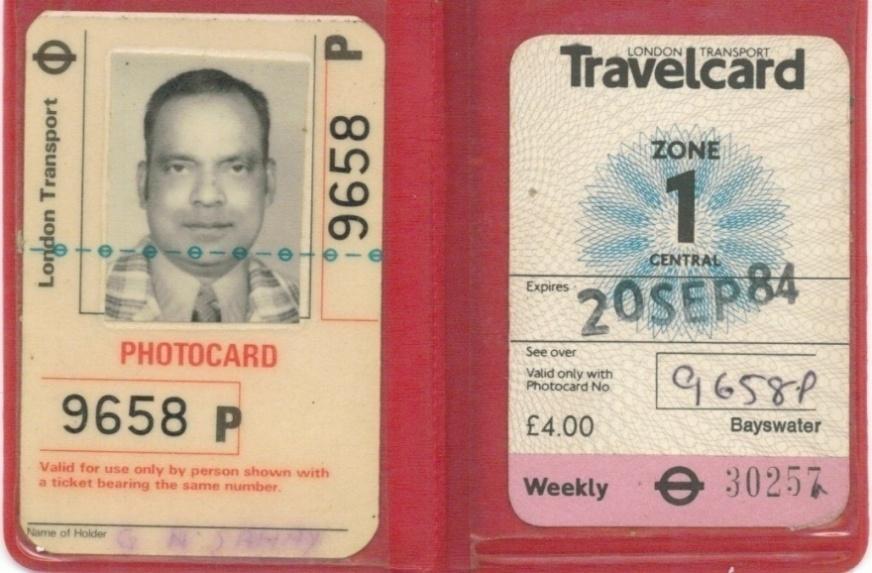
Bayswater was the nearest London underground station and only 5 minutes’ walk from the Westminster hotel through Moscow Road. It was recognisable by the famous symbol- a blue cross on a red circle-appearing on the station building. We had all brought spare passport size photographs necessary for purchasing a season ticket. Seeing a crowd of 18 men wanting to purchase season ticket one of the staff of the London underground- an Indian – came out with a pair of scissors and guided us how to prune the photograph further and affix it on the photo card. The season ticket valid for a week over the Central Zone of London encompassing almost all the important places of London bore a serial number which was also repeated on the photo card. Transparent plastic covers were provided on it for putting photo card on one side and the travel card on the other.
An escalator took us down to the underground tube station of Bayswater having a simple layout of two lines and two platforms connected by a foot over bridge. Beyond the platforms dark tunnel appeared with dimensions just beyond that of a train. The complete itinerary of the circle line (yellow colour) was available inside each coach of the train which we had boarded and there was no difficulty in finding out which station the train has crossed and which was to come next. We changed over to Bakerloo line (chocolate colour) at Embankment, for Charring Cross- the nearest underground station for our destination. As we emerged on the ground there was before us the famous Trafalgar Square. The British Council office is located in Spring Garden close to Trafalgar Square. At the appointed place there were to greet us Miss Judith Merrick of Technical Co-operation Training Department of the British Council and Mr. Allen Ewers, our Course Director from the British Rail Engineering School, Derby. There were introduction, coffee session culminating in payment of arrival allowance and daily allowance for the month of Sept. 84 and Oct. 84 in the form of Thomas Cook traveller’s cheque.
Next, we had to report to the Railway Adviser in the Indian High Commission located in the India House at Aldwych. There we were permitted to write letters to our home in India on Indian postage with promise to despatch them in diplomatic bag. With money in pocket and no more official engagement we dispersed in small groups.
Weekend on 15th & 16th September—In our hotel much emphasis on cleanliness of toilets was discernible and notices reading ’Please do not flood the bathroom. Thank you’. appeared at many places. There were ‘good morning’ wishes from the unknowns.
On 15th morning we had continental breakfast in the hotel dining hall which was hardly satisfying. But we overlooked it as roaming in the city was the uppermost in our mind. For this purpose, we had in our possession ‘London bus, tube and street map and tourist information’ a pocket size leaflet at no cost picked up from the Westminster hotel lounge. The leaflet provided an illustrated guide of tubes and roads in juxtaposition with the places of tourist interest. To facilitate spotting of a place the map was divided into different serially numbered squares and an index of places of interest and places of entertainment provided with the square number indicated against each. Marketing became our first choice. Places of interest could wait for future visits. We all purchased cameras either from the renowned Dixons or Argos and proceeded to Edgware Road tube station nearest to the famous Church street market which opens on Saturday only.
16th September was devoted to the Petticoat Lane Market, a famous street market near Aldgate/Liverpool Street underground station, known for bargain shopping. The market is popular for garments, footwear, bags, toys & eatables. It remains busy and vibrant, reflecting both its immigrant history and its continuing popularity with the locals & the tourists. But the newfound popularity of the market has put up price. All of them are battleground of wits. The market had attracted large number of visitors probably because it was Sunday when most of the shops remained closed. Scene in this market was like that in an Indian city as we came across street shops with the shopkeepers shouting to advertise their goods. At one place a group of singers entertained the public. The street was crowded, and one had to jostle to make his way. The London police constantly reminded the crowd on walkie-talkie in English, French and German about the presence of pickpockets and pasted stickers (bearing the photograph of pickpockets) on their belongings containing the instruction "Do not help them to help themselves".” Items like ties, briefcases and garments were available at reasonable rates although there was no assurance as to their quality.
London to Derby:- As instructed we completed our marketing spree on 16th in time to arrive the hotel by about 2 p.m. The hotel charge of 15 pounds a day covered bed and continental breakfast. We cleared our accounts by paying £ 30 each for two nights stay. The receptionist when approached gladly posed for a photograph with the group and also arranged taxis to enable us to reach London St. Pancras station of the British Rail. It was an all-black coloured Austin taxi with arrangement for keeping luggage in the front by the side of the driver and sitting in two rows facing each other in the back. The taxi was fitted with wireless set with which the driver kept on communicating with his controlling station. On arrival at St Pancras terminus the meter showed £4.50 but the driver was paid £5 including customary tips.

St Pancras railway station is a major central London railway terminus on Euston Road in the London Borough of Camden. The over-ornate & mock-gothic facade of the station building is of great historical & architectural interest. Surprisingly a road only separates it from the adjacent King’s Cross station. Beneath both these main line stations is “King's Cross-St Pancras” tube station on the London Underground; combined, they form one of the country's largest and busiest transport hubs.
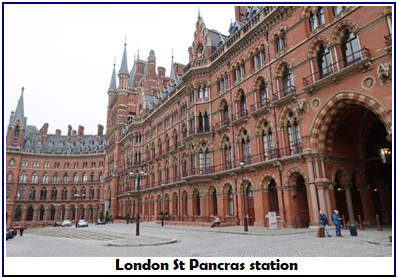
. We carried our luggage in a trolley from the taxi stand to the concourse. The elegant train shed with a single span covering all the platforms and lines was impressive for its simplicity and lightness. From a tablet fixed in the concourse it was known that the shed was fabricated by the Butterfly Company of Derby in the nineteenth century. The Railway porter transported the entire luggage in a self-propelled platform trolley on to the platform for putting in the luggage compartment. At the entrance of the platform from where our train was scheduled to leave the electronic indicator showed the next train to leave at 15.30 hrs. for Sheffield. Since our arrival in England three days back our movement was confined to London underground train. Hence, we were avidly looking for our first ever ride on a British Rail train. It was an ‘Intercity 125’ train signifying that the train was to run at a maximum speed of 125 miles per hour although the train was generally running at a top speed of 100 miles per hour. Two striking features of British Rail trains were the outward opening main doors and the automatic sliding doors at the two ends. Through the large sized fixed glass panes, we could have the first vision of the country’s fertile land, the building complexes, the grazing cows and sheep, the green foothills and the rivulets. The train stopped at Leicester for a few minutes and reached Derby past 17.00 hrs. The Railway porters unloaded the luggage and carried them in a trolley to the outside.
The dinner was arranged at the Midland hotel located adjacent to the Derby station building, across the road.

The dinner was sumptuous and was attended to by the Principal as well as the faculty members of the British Rail Engineering School. As I learnt subsequently, this hotel was going to be many weekend resorts during our stay at Derby.
The Welcome address-The Principal while welcoming us mentioned the following points: -‘Water not portable’ board would appear at the wash basin provided in our hostel room. But this was because of the law of land requiring potable water to be supplied directly from the pump delivery without having to go through the overhead tank. However, the water is perfectly safe for drinking.
An alarm bell button has been provided in every room near the bed switch, which can be pressed in emergency. When we mentioned that the same might be pressed inadvertently being mistaken for bed switch, the Principal replied that normally not much serious attention would be given if the alarm button was pressed only once.
Plenty of playgrounds are available in the school campus which can be made use of for morning walk and jogging, as noticed in case of trainees of the previous batches.
After finishing our dinner, we were transported in the school bus to the hostel of the British Rail Engineering School (BRES) located on London Road at a distance of about 2 kms. from Derby railway station. We retired in our allotted rooms.
The British Rail Engineering School (BRES), Derby
It provides training in technical matters for staff of the electrical engineering. and the signal & telecommunication engineering. department of the B.R. The school is set in its own grounds in one of Britain’s busiest engineering centres. The main buildings date from 1938 to accommodate the London Midland Scottish school of transport for training operating staff. The imposing building incorporates five classrooms, a fully equipped cinema, a library and single study-bedrooms for the students.

The India House -We were accommodated in a block named ‘India House’ as it was a batch of Indian Railway Officers receiving similar training in the past who first occupied it.
My hostel room number was 515. The single study- bedroom was provided with
an easy chair and a cot on one side of the passage and a wash basin, wardrobe and reading
table on the other side.

The heating panel and a large window with a moveable glass shutter formed the third side of the room opposite the door. In fact, by turning the glass shutter to different inclination and admitting different quantity of outside cold air we were able to achieve any temperature of the air inside the room when heating panel was operative.
The toilets: - They were common. Unlike our bathroom’s ‘shower’ designed to bathe in standing position existed, without mug or bucket. The taps of the ‘shower’ were so designed that hot and cold water were running simultaneously and by suitable manipulation of knobs, we used to get desired temperature of water. A Nova toilet soap supplied for our use was replaced every Friday.
The kitchen room- Here tea, coffee, chocolate, milk powder, sugar and electric kettle were kept for preparation of hot drink at our will. The stock of these materials was regularly replenished by the room maid. After use we washed the cup/spoon ourselves and wiped them with paper towel available in the form of continuous roll on a towel master, hung from the wall. Centrifuge washing and drying machines, soap powder and electric iron were also provided in this room to enable us to keep our clothes laundered and pressed. The washed clothes after rinsing in a sink were dried in a centrifuge and then ironed. It was a favourite spot for a get-together in the morning of the weekdays (for morning tea) and Sunday evening (for evening tea on return from two days outing) and for washing clothes. It was also a place for displaying notices. One day I found the following notice here: ‘Those wanting hard beds may kindly indicate’. A couple of fellows exercised their choice by making endorsement.
The messing-It was designed to cater for the special taste of Indian and we were regularly served rice, yogurt, dal and sambhar. Other items included soup, boiled vegetables, salad, apple, peas, & beans. A little involvement from our side in the cooking affairs had its desired results and the cooks were very receptive to our suggestions. The British normally drink wine/beer at such moment and many of them would first visit the school bar to return with a glass of drink which they would consume while eating. The items of fruits consisted of malta, pears, banana, and grapes. After lunch/dinner biscuits, cheese, cheddar (a delicious cheese from Somersetshire) tea/coffee was served. The people there are accustomed to taking cold milk with tea/coffee but on our request, there used to be another jar of hot milk. While the items of food were kept in bowls on the dining table, we were required to line up at the kitchen counter for eggs. One dining table was exclusively for us while other tables were meant for trainees from the B.R. Beside the dining table there were pigeon holes for keeping the napkins but the wash basin for washing hands or rinsing was not provided in the dining hall.
The school club: -Outside working hours it provided relaxation to the students in a variety of outdoor games, board games, table games and cards. All course members had to pay a subscription of £4 for membership of the school club which allowed us to use the bar and club amenities.
Our bank: - In arrangement with the school authorities, the representatives of the Midland Bank called on the school on the very first day, i.e. on 17.9.84 to help us open our bank account. In a couple of days, we were in possession of cheque book for withdrawing money from the bank during business hours and auto card with a password for getting cash in form of new currency notes at odd hours from the computers installed on the bank building and communicable from roadside.
The Card Passes: - The British Rail had supplied each one of us two first class card passes for movement over the British Rail system. One was free pass for movement required in connection with training and the other 50% concessional pass for movement connected with personal work. When we asked the Course Director to explain the difference between the two he said,’ please do not ask this question’.
My postal address for the duration of my training: -
G.N. Sahay, IRO (9th Senior Management Course)
British Rail Engineering School. London Road, Derby, DE2 –8 UX ( United Kingdom)
The routine on the weekdays: -
Breakfast 08.00 hrs. (In the dining hall).
Class 09.00- 10.30 hrs. (Room 109, Astel house))
Coffee break 10.30-11.00 hrs. (In the lounge)
Class 11.00-12.00 hrs. (Room 109, Astel House))
Lunch 13.00 hrs. (In the dining hall).
Class 14.00- 15.30 hrs. (Room 109, Astel House))
Tea break 15.30-16.00 hrs. (In the lounge)
Class 16.00-17.30 hrs. (Room 109, Astel House)
Dinner 18.30 hrs. (In the dining hall).
Class 19.30-21.00 hrs. (Room 109. Astel House)
There were no tests for us to write. Nevertheless, sometimes a project was assigned as homework and subsequent presentation in the class. We were careful never to embarrass the host by our actions. But once in a while one of us would light a cigarette, stand on table and emit the smoke directly on the fire alarm vents at roof with a view to causing panic. But it went unnoticed.
The routine on Friday: -It was different from other weekdays. The classes used to be over at 3 P.M. Our handbag with shaving kit and sleeping suit was kept ready in the morning hours itself. At 15.15 hrs the school bus was ready to take us to Derby railway station. Dag, the bus driver, would smile and wish happy weekend while taking leave of us after dropping at the station.
Saturday and Sunday- There was no question of staying at the hostel on these days.
Stay at the Midland hotel, Derby- Those who wanted to spend their weekend at Derby itself were accommodated here. Opened in 1841 it is styled on Victorian grandeur. This hotel took pride in the fact that it had played host to many famous guests including Queen Victoria. On 28th September 1849 while travelling from Balmoral Castle to Osborne house ,she accompanied by the Prince Albert and the Royal family, stayed overnight in this hotel. A copy of the menu served to her party was displayed in the cocktail bar. Some of the suites in the hotel were named as ‘Darledale’, ‘Smalldale’, ‘Cheedale’. It offered English breakfast which included additional items like cornflakes, milk and eggs/sausage/bacon. But it suffered from the drawback that there were no toilets en-suite. The hotel was once owned & managed by the London Midland Scottish Railway and subsequently by the British Rail .But with progressive decline in its non-operational activities the hotel was privatised and sold in 1982
Stay at Cora hotel, London- Those who preferred London caught the train for St Pancras for stay at the Cora hotel on Tottenham court road, near Warren street tube station and Euston station of the British Rail. This hotel rooms had toilets en suite but continental breakfast was served. We were at a loss to understand as where to wash the clothes and how to dry them. There was no choice before us than to use the bathroom tub for washing clothes and the room heating panel for drying them during nighttime. We were however careful to remove them from the heating panel while moving out so that it did not attract the attention of the room maid when she came for servicing.
It was during course of stay in this hotel that I met Mantreshwar Jha (an IAS officer of Bihar cadre) who was undergoing training at the Royal Institute of Public Administration with other IAS officers. I had accidently picked up acquaintance with him when he shared the breakfast table with me.
Stay at a choice place-. If any one of us wanted a third place he would make his own arrangement and the British Council would reimburse to the extent of £15 per day. The choice was to be exercised by Tuesday for the coming weekend.
The school remained almost unmanned during the weekend at the care of watchdogs and we had instructions not to return until Sunday afternoon. When we returned to the hostel after meeting the deadline, we made our entry through the ‘night entry door’ for which all of us possessed a common key. The door closed and locked automatically after one entered inside.
The weekends train services - On Saturday & Sunday the train services were grossly curtailed and we availed of the bus service arranged by the B.R. for carrying the passengers from Derby station to an important junction station ‘Alfreton Mansfield’ wherefrom convenient train services were available for different destinations. This bus journey incidentally enabled us to have a good view of the countryside. The weekends were utilized for visiting places and meeting friends & relatives.
The institutional training at Derby
The Senior Management Development Program was designed to equip the Railway managers with advanced leadership skills and strategic insight including change management, decision-making, Inventory control, financial management & functioning of the British Rail, so as to effectively lead the teams and drive organisational success in a highly complex work environment that can be stressful and rigid.
The Course Director- He was Allen Ewers, a retired British civil servant drafted specially for management training of the Indian Railway officers. In less than a week’s time Allen knew our names and our discipline; such deep was his involvement into our affairs.
It was he, who first received all the incoming mails, would visit our seats in the classroom and place the letters on the table prior to commencement of the class every day or personally hand us over in the lounge during tea/coffee break. Even when we were away from our school during the Attachment training, we received our letters as usual because of elaborate arrangement made by him. Allen had found out from our dossiers our birthdays and used to greet whosesoever birthday came during the period of the training. My birthday (13th. October) happened during the training period but as it fell on Saturday it went unannounced. In informal gatherings Allen encouraged us to have fun and frolics saying, “A course is as good as you make it”. Since there is no system of peon in England Allen would himself bring water for the guest lecturers and take the trouble of closing the door after the classes were over. England is a country of primness, propriety and punctuality. Our British Council technical Officer (Miss Judith Merrick) in her letters addressed to us always reminded that we met her only by prior appointment; otherwise, it might be a wasted trip.
The first day of the school:- It started with group photography in the backdrop of the Main entrance door on which the word STET FORTUNA DOMUS (May the fortune of this house endure) was inscribed. The 18 trainee officers including one lady officer from the Indian Railway Accounts Service. The Principal of the School and the Course Director participated in it. We were then tempted to make a reconnaissance of the school building. There were three lounges having T.V. sets and sofas. One was specially allotted to IRO (Indian Railways officers) where we waited for our turn for tutorial on attachments – a line training which we were to undergo from 8th week to 11th week at British Rail installations, London Underground & production units manufacturing railway equipment.

The tutorial was conducted by the Principal, the Course Director and experts from the British Rail and the London Underground. The intention was to have an insight into our qualifications, experience and aptitude so that the training during attachment period could be suitably designed.
The Classes at BRES, Derby: - Our classroom was Room No.109 in the Astel House– a building constructed in the year 1980 and having similar appearance as the three-storey bedroom block the ‘India House’.

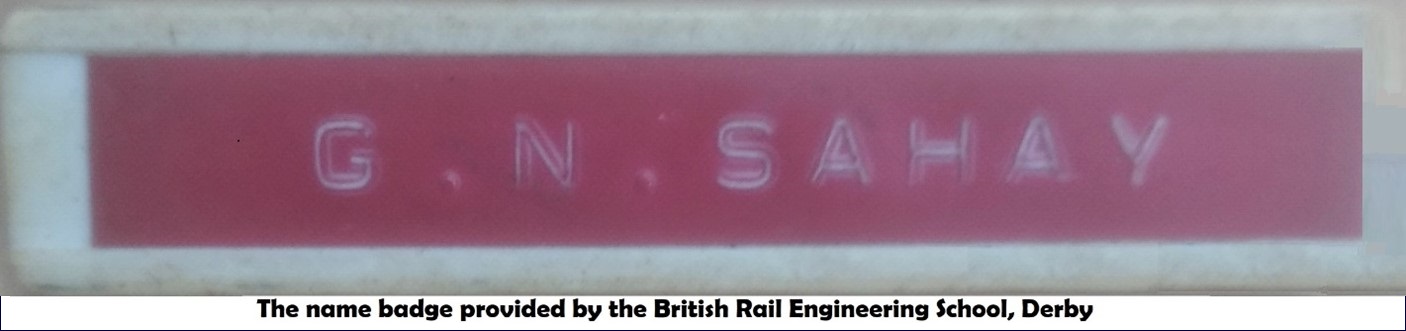
Tables for 18 officers were arranged in ‘U’ shape around the Speaker’s desk. Name plate placed on the table displayed our name followed by the word IRO. We were also expected to display our name badge, supplied by the school, on our apparel. Sketch pens were used on white boards by the speakers for writing purpose. Slides, video films, epidiascopes, and flip charts served as training aids. Blank papers were kept on the speaker’s table which we picked up ostensibly for taking notes. But Allen knew that we hardly used them for this purpose.

The syndicates: - In the first task allotted to us, we were asked to form syndicates (group of 4 to 6 persons) and describe the door/gates of the BRES with a sketch. As we were puzzled at the suddenness of the task our tutor pointed out that the objective must be defined in the beginning i.e. whether underlying consideration is security or firefighting or logistics. He also made us realize that for a group to be effective it must choose a leader. However, he allowed us to have a round of the school before undertaking the exercise.
Concessional passes for foreign Railway- Railways of foreign countries issue concessional passes to the staff of Indian railways on reciprocal basis. Generally, it is at 50 % concession. Shortly after settling down at Derby we sent request letters to the headquarters of French, Belgium and Denmark railways for issue of concessional passes for specified journeys, enclosing courtesy letters issued by the Indian railways. In a short time, we got them.
The Syllabus- It included a number of interesting and informative topics e.g.
Effective Communication: - In it we were asked to speak on non-Railway subjects. Our speech was video recorded and replayed on T.V. screen followed by comments from tutors and colleagues. More emphasis was laid on posture, gesture and gesticulation. The speaker must keep eye contact with the audience but keep changing every 45 seconds. The tutor advised us as under:
-
Before starting a speech, one should spell out what he/she is going to speak about.
-
At the end the speech should be summarized.
-
Questions should be invited.
Interviewing technique: - Here the tutor interviewed us first and then offered himself in three different roles to be interviewed by a panel of trainee officers. In the first role, the tutor was an aspirant for a higher managerial post. As he entered the interview chamber, he threw his hat on the floor, drew a chair and took his seat without the permission of the chair. At the end of the interview, he appreciated the way in which we ignored his unbecoming actions and proceeded to discover his suitability for the post. In another role, the tutor with professed knowledge of English and French was being interviewed for appointment. In the third role the tutor faced a disciplinary proceeding and had to explain his conduct. He entered with a grim face carrying an overcoat in his hand. He expected us to relieve him of his burden which we had overlooked. He also asked our permission to smoke which we granted but which according to the tutor should have been refused in the context of seriousness of the charge. The entire sequence was recorded, reproduced and critically analysed by the tutor, the trainees and the Course Director.
Logmanex –-It was an exercise in management of a production unit covering topic like inputs, production planning & marketing of the end products.
Industrial relation:-Two personnel managers of different ranks had come from the British Rail to impart a lesson on this subject. They stated that trade unions were welcome to put their demands and the management should not grudge conceding the reasonable ones In case of differences the bargaining process may go on but at the end of the day the decision of the management should prevail. Incidentally it was seen that they addressed each other by the first name despite difference in their rank.
World trade game:-The participants representing different countries were endowed with either capital or raw materials or factories characteristic of that country. With no rigid rules about the conduct of the game, one had to make the best use of what he had in collaboration with others to maximize the profit.
Logistics, computers in inventory control and operation processing.
Speakers on subjects like Group & Interpersonal Skill Development, Financial Management, Market Research, Logistics, Inventory Control, Industrial relations, etc. included scholars from universities as well as managers from public & private bodies. Charles Underhill, the Principal of the school and Allen Ewers, the Course Director also took up subjects connected with the British Rail. Great emphasis was laid all along on making the objectives clear before undertaking any exercise & on time planning.
The guest speakers: -After a guest speaker had finished his lecture our course leader would invariably rise to thank him and sometimes even present him with souvenirs (cigars, sandalwood etc) brought from India from the fund created by contribution. The British loved it. It was a moment of rejoice to us to find Dr. Jyoti Majumdar, as our guest speaker to teach transport economics. Jyoti, an ex. member of the Indian Railways Service of Engineers had come to U.K. for management training like us. After his training was over he was persuaded to stay and do teaching work at the University of Bradford. While teaching he did his doctorate. Recently he resigned from the Indian Railways to take full time job in the University of Bradford. He, however, retained his Indian citizenship.
In lighter vein: -The serious atmosphere of the class was sometimes broken by quips and comic interludes. During our training the English cricket team had come to India and had badly lost in the first test. The English guest speaker before starting his lecture remarked that he had bad news to break and that the English cricket team had lost to the Indian team. He wanted to know if the news was good or bad and there was an outburst of laughter. On another occasion, the class burst into applause for a guest speaker who wished us good luck in Hindi with the help of a paper written in English script. There were some unhappy moments also when in our informal discussions one of our hosts suggested that we were confining to ourselves and not mixing with British people. We had no excuse to offer. At one stage referring to an American guest speaker his British pal mentioned that he too had the same fate as us ,implying thereby that we both were once ruled by the British. One guest speaker before starting his lecture asked us to guess his nationality. All sorts of replies came e.g., English, American, French, German; Dutch…The speaker set aside our conjectures and proudly announced that he was a Scottish. We could discern that Scottish believed in maintaining their own identity in the United Kingdom.
The sound of the buses of the City Transport whose garage was located next to the school also sometimes provided a good break from the drab lecture.
BST and GMT: -The summer time (BST) of U.K. is one hour ahead of the Greenwich Mean Time (GMT) and during this period the difference between the U.K. time and Indian Standard Time is four & a half hours. The U.K. time is put back by one hour on a Saturday night during the last week of October allowing people an extra hour in the bed on the next Sunday. The U.K. time is thus brought at par with the GMT differing by five and half-hours from the IST. This happened during our stay.
Guy Fawkes day:-Guy Fawkes during James period had ventured to burn the houses of Parliament when he was caught. This day is celebrated with zeal by burning his effigy. It is told Guy Fawkes was spotted in a lantern light & the guards of the Parliament even today use lanterns on this day. Since we did not know about this guy Allen came to the board to enlighten us.
Diwali at Derby - We had celebrated Diwali festival during our stay at Derby. However, we had sought the permission of Allen and Charles and taken care to inform the local police beforehand so that they were not alarmed at the sound of bursting crackers.
Derby railway station - It is a premier station of the London Midland Scottish Railway (LMSR). It lies on the Main line from London St Pancras and Leeds. Local services from Nottingham to Matlock along the Derwent valley also serves the station. The station has lifts providing step-free access to all the platforms from both ends of the station. Midland hotel adjacent to the railway station is the oldest extant purpose-built station hotel in the world. The original building is a red-brick construction with a rectangular plan ,3 storeys high. A stone cornice runs beneath the second floor windows.
Coming from the BRES ,after crossing a series of blocks belonging to the British Rail Technical Centre on the right side and the British Rail Engineering Limited on the left side (Connected through a siding passing below London Road) one would come across the ‘Department of Health & Social Security’ (DHSS) and the Royal Mail before meeting the station approach road (Midland road).

The main Post Office, the Clarendon Hotel lay on this road. Beyond the station on the London Road was Gables Hotel for another batch of trainee officers from the Indian Railways. On the station approach road (Midland Road) there was an unmanned newspaper stall where a bundle of newspapers were kept beside a coin box. Such was the sense of honesty that the purchaser would put the price in the box first before picking up the newspaper. Derby station has a commodious portico crowned by British Rail logo. In its impressive enquiry office, the enquiry clerk would give the required information about train timings by scribbling on a piece of paper bearing the monogram of the B.R. Various brochures like ‘Family Rail-card’, ‘Intercity Savers’, ‘Bike it yourself’, ‘Sealink’ were available free or at a nominal cost. Said the enquiry clerk one day jocularly, “Please do not ask for piecemeal information for a journey involving change of trains. Please state your destination straightway. It is easier to give information for a journey from London to Moscow than from Harwich to Blackpool”. Metal badges of British Rail logo, locomotive, and coach were on sale at prices up to £1. Timetable sheets on board indicated the timings (representing the train number also) for trains to different destinations arranged alphabetically. The timings were so designed that trains for a particular destination were leaving exactly at half hourly/hourly or two-hourly intervals so that only the hour changes but not the minutes. Pocket size card timetable and notebook covering train journey for selected destinations were available free.
3 sets of timetables exist eg (i) for Monday to Friday, (ii) Saturday and (iii) Sunday. Services are grossly curtailed on Saturday & Sundays as many sections are blocked for engineering repair works. In order that the long-distance passengers are not inconvenienced on these days the B.R. provides convenient bus services. The station was planned for large scale renovation and periodically posters would appear apologizing to the travelling public for inconveniences and indicating the latest progress vis-à-vis target.
The city of Derby-- Derby city in English Midlands is located at a distance of about 220 kms north of London. The city has a large spread. The name of Derby became linked with horse racing through the Earl of Derby who does not live in Derby or near it but holds title as an honour conferred on him hundreds of years ago. Despite its rapid expansion over the last 100 years to a thriving industrial town of more than 2 lakhs people, Derby city has retained much from its past. The most striking building is the Cathedral with its pinnacled tower. Derwent flows on the north of the city. The Derby city centre is focal point of the nine important roads including London road, Mansfield road and Nottingham road.
Memorable places at Derby-
British Rail Technical Centre (BRTC)- It is the Research, Designs & Standardization wing of the British Rail. It ensures technical support in improving equipment, operating practices and technological base for future business success.
Some of its present activities include bus bodied 4 wheeled metro cars, Advanced Passenger train (APT) and Magnetic Levitation (MAGLEV). One day we were taken to this place for an interactive session in the conference room. But we were not allowed inside
British Rail Engineering Limited (BREL)--The most significant activity both in terms of sales & manpower continues to be repairs to the rolling stock for the British Rail. The other activity is new construction requirement of BR in accordance with the needs of the rail business. It also aims at capturing world export market by its new range of products including the Rail Bus and recently launched International coach & its derivatives. Both the units are located at Derby occupying a fairly large area between the BRES and the Railway Station.
DIY supercentre–Located opposite to the school it sold items of automobiles and house furnishing.
Willmortan Post Office- it was our popular stationery shop at stone’s throw distance which satisfied our need of envelopes, writing pads, postage stamps and other stationery items.
Swap shop: -It was on the London Road on way to Derby station where an old man would buy/sell second hand and vintage items. His shop door was so designed that it would cause a ringing sound when opened by a customer. The shopkeeper would normally sit in an interior room out of our view but would soon appear before us on hearing the ring.
Eagle: -It is the main market centre with a series of big stores viz. ‘Argos’, ‘Boots’, ‘Mothercare’, ‘Sainsbury’, ‘Woolsworth’, ‘Primark’ ‘Dixons’ ‘British Home Stores’, ‘Marks & Spencer’ and ‘Debenham’ all accommodated in the same block. In ‘Boots’ tester samples of perfumes including renowned ones like Charlie and Intimate were kept for trial free of cost and we had no hesitation in helping ourselves liberally. ‘Sainsbury’ was our favourite destination for purchasing eatables like bread, butter, cheese, milk, soup, raisin, chocobars, etc. Here I had purchased cake powder. Back at home it was consumed without due processing. Such was its irresistible taste. For washing and printing the photographs the used film roll was given to the shop and the developed photographs were mailed by them to our school address. From Monday to Friday, deep involvement with study left no room for us to do marketing. So, on Friday afternoon after we were freed near ‘Midland Hotel’, we lost no time in ‘checking-in’ and after dumping our luggage in the room hurrying to the Eagle Centre for shopping. Our daily allowances were sufficient enough to leave scope for saving. Children congregating below chestnut trees to pluck the fruit was a common sight while returning to the hostel from the Eagle market.
Pub: -There was a pub opposite our hostel named The Navigation which relates to the canal navigation which once upon a time passed behind the school and under London road alongside the pub. The bed of the canal is now footpath.
City bus: -Number 42 to 47 (destination Boulton Lane) to Ascot Drive provided easy communication with the city centre.
Places visited in course of Attachment training :- During the attachment period I had to visit the following places which are either centres for manufacturing railway equipment or establishments of the British Rail/London underground.
Cheltenham Spa - M/s Dowty Hydraulics.
Giltbrook(Nottingham) -M/s Permaquip.
Sheffield -M/s Henry Boots.
West Ealing -M/s Plasseur (manufacturing track machines)
Bedford - M/s Matisa (manufacturing track machines)
Castleton - Flash Butt welding plant of the B.R
Acton -P Way training school of the London Transport.
Willesden - Formation of Speed links
Tinsley - Functioning of hydraulic retarder.
Leeds - Carriage Depot at Neville Hill.
London Marylebone station -Project management.
Sheffield: -- Sheffield’s reputation for manufacturing has been the enduring identity of the steel city. Sheffield is a vibrant city bursting with character and creativity. It is the busiest station in south Yorkshire. I was assured that on the appointed date and time I would be received at Sheffield station by designated persons.
 I was worried as to how they would spot me. But a pleasant surprise was awaiting me in the form of two persons who interrupted me at the exit and gently asked,” are you Mr. Sahay? I hope I have pronounced your name correctly. You are a family of five. You are vegetarian.” I was overjoyed and asked as to how they could recognize me and know all these about me. Thereupon they showed the photocopy of my dossier containing my photograph, family details and my food habit all filled in my own handwriting. They were men from M/S Dowty Hydraulics. Sheffield. I was straightway taken to Tinsley Marshalling yard to see the performance of Dowty Hydraulic retarders (a device used in the marshalling yard to retard the movement of the wagons shunted across a hump). This was followed by lunch. The British Council had booked Hunter’s house hotel for me. Because of my preoccupation as above I reached the hotel late afternoon. The counter clerk while welcoming me remarked; ‘sir, we were informed of the British Council arrangement in time and looking for your arrival since morning’. I apologized for late coming although it was not necessary. When I entered the lounge a very interesting TV programme was awaiting me in which trained dogs were guarding the sheep rounding them up in the evening and herding them into their shelter.
Cheltenham Spa-It is one of the finest spa towns of Europe. Its fortune was made about two hundred and fifty ago when a mineral spring was discovered by means of watching the habit of extremely healthy pigeons according to tradition. The promenade is dominated by municipal office, Queen’s hut and the Imperial gardens. Incidentally, spas are named after the watering place in the Liege province of Belgium where hydropath was developed from 1626.I came across a house in the town on which a plaque was fixed stating that Edward Jenner (the inventor of Smallpox vaccination) once lived in it.

There used to be an allegation that the Asians were subjected to discrimination in the matter of allotment of paying guest accommodation. Only once during my whole stay I had the chance to be a paying guest to Mr. Curtis at 1 Suffolk Square, Cheltenham Spa. It was British Council arrangement. The house had all the comforts of the Westminster hotel. Mr. Curtis served the breakfast while his wife was busy supervising the proceedings and preparing the bill. The hosts treated me with due courtesy.
Birmingham- Birmingham New Street is the largest and busiest of 3 stations of the city and central hub of British Rail system. There is a great concentration of industry in the city with factories, workshops and head offices of international concerns. The use of magnetic forces to support and guide a vehicle provides an alternative to the steel wheel on rail. In MAGLEV, the vehicles fly silently, and maintenance costs are reduced. The West Midlands county council has adopted a passenger link between Birmingham International station and the adjacent Birmingham Airport. We had a free ride on this MAGLEV car, which covered the distance of about a km between the above two terminals in ten minutes. In the Science and Industry Museum the steam locomotive ‘the City of Birmingham’ is kept on rails brightly painted in its original livery. At an appointed time every day the locomotive moves on rails for a short distance powered by a hidden electric motor amidst playing of tape-recorded sound of the puffing and whistling of steam locomotive as if gaining acceleration after starting from the station. For taking photograph of the locomotive permission is required, which is generally granted after filling up a form.
Manchester-It is the second most important commercial, financial, banking centre and newspaper centre. While being taken to the Signal Box (akin to Route Relay cabin of the Indian Railway) and the central enquiry/reservation office at Manchester Piccadilly station we were asked to wear orange colour vests as required under Railway rules.

Here I purchased overcoats for my daughters. While returning from Manchester Piccadilly after training I was waiting at Sheffield station on the nominated platform for a changeover to Derby. On noticing a foreigner waiting on a lonely platform a railway staff approached me to ask if I intended to go to Derby. On confirming he said, ‘Sir, it seems you have missed the announcement. There is a change in the platform for the train to Derby. Please move to other platform for your train’.
Preston-The station yard was being remodelled to simplify the layout. There were notices all around the station on behalf of the B R giving the details of the work and apologizing for the inconvenience caused to the passengers. I was deputed to see this work during my attachment period. This opportunity was made use of by me to meet. S.K.Sinha, a doctor at the Royal Preston Hospital. From the station I got into a bus and requested the driver to remind me at stoppage nearest to the hospital. He obliged me dutifully. On reaching the hospital, I sought the help of the enquiry clerk who took out a printed map of the hospital complex and marked with the help of a coloured pen the residence of the doctor. This proved helpful to me in reaching the destination.
Attachment with the London Transport- When I reported at the 55, Broadway, headquarters of the London Transport for a day attachment I was immediately issued a guest ‘London Explorer’ card for unlimited travel on the London underground & on the London Transport buses.

I also had the privilege of a ride on the driver’s cab of a London Underground train from
Westminster to Embankment and a feel of how it is to travel through a tube. I noticed the
safeguard provided to the driver. Such was the mechanism that unless the driver closed the
side shutters the train would not start.
It pleased me to find that whenever I entered an office, which was invariably centrally heated, I was approached with great courtesy to part with my overcoat to be placed on the hanger. We were entitled to hire taxi to cover our journey between railway station and hotel/place of training. While visiting the Willesden yard, which is the main marshalling yard of London area and Manchester Piccadilly station signal box I was asked to put on HI VI vest (orange colour) which my host carried as spare. During visit of a workshop manufacturing Points and Crossings I was approached to wear a helmet.
Other cities and towns of U.K. visited at weekends
1.The Romance of London:- During the 3 days (from 14th to 16th September) since my arrival in London and during some subsequent weekend visits, I moved widely and was highly fascinated by the natural charm, the sights & sounds of the city. History whispers in the time-worn taverns, inns, pubs, dormant churches, victory arches and period dresses unravelling the romantic nostalgia of a bygone era. It was talked about London,” If you are lucky the fog disappears, and you can see the rain.” But fog is a thing of past and one can face rain with a conventional umbrella. The London Metropolis consists of City of London on the east side and City of Westminster on the west side. The signage on the face of buildings at crossroads indicate the city in which the visitor happens to be. The London Tower manifesting an aura of medievalism and the adjacent Tower Bridge embodying the marvel of Victorian engineering are the acclaimed landmarks of London. They are floodlit in the night. This imparts prominence and elegance to them and carries an assurance that they are inculpable. The parks and gardens become London’s paint box by day. The night illumination embellishes the city with jewellery. The growth of London has been casual and unplanned. There has been no concept of broad avenues radiating from a resplendent centre. Yet the spread of the city is self-restrained. The city is majestic in its obscured treasure of lanes, alleys inns and pubs. For exploring it one needs only an illustrated guide map and a London underground season ticket. No place in the city exceeds a few minutes walking from the nearest tube station.
-
The Riverside:- The historic and serpentine Thames is also known as ‘The Ribbon of London’. It meanders on its way from west to east and is the old enduring lifeline. The watercourse is guided. The river not only cuts through the urban landscape but also interjects a number of fragmentary inlets between houses, beyond gardens and behind warehouses. The Victoria embankment offers an ideal platform to sit and admire the serenity of the river.
-
The Tower Bridge: -Built about 100 years back its Gothic towers of stone house the steel structure carrying the bridge mechanism, which is raised everyday around 11’0 clock to allow the waiting vessels to cross over. It is said that the lifting mechanism has never failed to operate the two 1000 tonnes Bascules in 90 seconds. Though this is a daily exercise arising out of operational necessity it takes the form of a great event watched by thousands of tourists. One day I witnessed this event. The police carefully cordoned off the two sides before the central portion was allowed to open in the form of inverted V. The giant engines which motivated the Bascules during Victorian era are on display inside the bridge tower. The high pedestrian walk was permanently closed about 60 years back because it was misused for suicides.
-
Buckingham Palace:- The palace is symbol and base of the British monarchy. The Standard flies when the Monarch is in London. Soldiers in scarlet uniforms of the last century with rifles (unloaded) protect the palace. The ceremony of change of guards takes place at 11 a.m. on the forecourt & for a while the traffic is at a standstill. I watched it one day. The traditionally dressed guards with fur caps covering the entire forehead arrived amidst playing at band and joined the off-duty guards in a parade. The latter then dispersed playing band. The event was watched by thousands of tourists. There is a famous cartoon on this subject depicting the photograph of a tourist asking an embarrassed London police “But you say the Buckingham Palace guards are so good, how come they keep changing them?”
-
Downing Street:- No.10 has been the official residence of the Prime Minister and No.11 that of the Chancellor of Exchequer. The street astonishes visitors by their pettiness.
-
The Houses of Parliament:- The stately building is located on the north bank of the Thames river with the Westminster Bridge overlooking the House of Commons terrace. The Houses are open to the public on Saturday and on most holidays. The interior of the house is lavish, rich in pictures, staircases, furniture and acquisition of traditions. When the Parliament is sitting a flag flies on the Victoria Tower by day and a light shines above the Bigben at night. Big Ben is not the name of the Parliament Clock but the bronze hour-bell. The clock is a good timekeeper to the nation and has hardly stopped. Police regulations have it that no major demonstration can approach Parliament.
-
The Trafalgar Square:- It commemorates the battle of Trafalgar.
The Nelson Column in the centre is dedicated to the admiral Nelson who authored British victory against French fleet in this battle. Some weekends the square is for marchers and demonstrators. The hundreds of pigeons ever eager for group photography with the tourists in return of bait are a bane for the city Fathers but delight for the visitors.
-
Westminster Abbey:- It has been at the centre of British life and History and final resting place of British monarchs and political leaders. It has also seen many a momentous occasions – royal crowning of monarchs, weddings and royal funerals.
-
Whitehall:- The wide thoroughfare that runs from Trafalgar Square to Parliament Square is Whitehall which is a congregation of government offices.
-
Soho:- With its bright light and idling crowd Soho is a congestion of narrow, old streets. The shops and stalls set up by the refugees of many nations (including India) have made the streets crowded. It has many billboards advertising themes which will be construed as morally outrageous in India. The London police appeared vigilant to ensure that no sinister activity goes on in its clubs, restaurants and boutiques.
-
Hyde Park:- The Speakers’ Corner provides a secure platform for questionable speeches on Sundays. Moslems shout at Christians, liberals debate with conservatives and the eccentrics give speeches even without audience. It is said that those trying to come up in the politics use this ground for practising oratory and withstanding cross questioning. Apparently, such activities of the speakers are free from restriction and restraint. But in reality, these are under constant surveillance by the police.
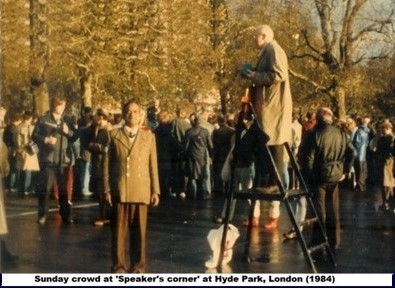
There was a good-natured heckling all around during my visit on a Sunday. I spent some time in listening to the nonsense of a speaker who could not attract audience and got myself photographed opposite him.
-
Lord’s Cricket Ground:- It is the premier cricket ground in the world. It is the ambition of every overseas cricketer to play at the Lord’s.
-
The Oval:- It is the Surrey Cricket Club ground for the final test match every season.
-
Piccadilly Circus:- Advertising lights spin restlessly round the little winged figure of EROS surmounting a fountain. They say that if you stand at Piccadilly Circus or sit on the terrace of the fountain long enough you are likely to meet most of the persons you know and also many more you do not know.
-
Madam Tussaud’s:- The display of wax statues has a much wider appeal and includes sportsmen, politicians, pop idols with suitable colour, smells and sounds. Almost everything displayed except the actual bodies is authentic including the guillotine.
-
The Albert Hall:- The giant rotunda can hold 8000 people. Though it is a popular concert hall it suffers from poor acoustics.
-
Greenwich:- his is about 10 kms down river. The boat trip through the Port of London is fascinating and much the best way to approach this seafaring town famous for the Royal Naval College, the National Maritime Museum and the old Royal Observatory on the Greenwich Meridian. People were eager to get photographed standing with their legs- one on either side of the Meridian with zero longitude.
-
New Scotland Yard:- It is the headquarters of the London police.
-
The London Dungeon:- It has enormous medieval torture chamber. It is not suitable for young children and persons with weak heart.
-
The Buskers:- They are peddlers of music. They play piano accordion, guitar or fiddle providing one of London’s oldest and liveliest traditions.
-
Lollipop girls:- Sometimes ladies wearing yellow vest displayed ‘stop’ board to enable unescorted children to cross the road.
-
Guide dogs- They are provided orange/yellow straps and trained to identify signals and not to get excited at the sight of another creation of their kind. They were seen helping their blind masters to cross the road.
-
Cars-They are mostly of 5-doors type, the rear door used for accommodating pets.
-
Cyclists-They put on yellow/orange coloured vest/ strap to make themselves distinguishable. The following notice appeared either on a transport bus or on hoarding, ‘Use light at night; Wear something bright; always be seen’.
-
Post Office- Multipurpose counters serve the customers in respect of postage stamps, registration, money orders etc. There is nothing like postcards, inland cards, or stamped envelopes. First class mail with promise for delivery the next day anywhere in U.K. requires 17 pence stamp while second-class mail with ordinary delivery period requires 13 pence stamp. Pin codes read like DE 2-8 UX, BN2-IAE, and SW3-INU. At most of the post offices, book containing assorted postage stamps worth 50 pence is available on insertion of coin in a machine. Postage stamps are also available in stationery shops. Valuable documents like passport could be sent by Recorded Delivery Post costing less than the registered post without any apprehension of loss or pilferage.
-
Departmental stores:- Most of the things sold in U.K. were imported from Hong Kong, South Korea, Japan, Macao, Taiwan, Spain, Italy and France. Famous departmental stores:
Dixons in cameras and electronic goods. Marks & Spencer, Woolsworth, C&A, British Home Stores and Debenham provide great attraction for purpose of garments. Tables correlating the trade number of the garment with the age/height of the children were displayed inside shop. One need remember either age or height to get the correct size. Boots is popular for items of stationery, cosmetics & perfumes.
Sainsbury is renowned for food items. Since the departmental stores are of enormous size, they employ various surveillance devices, like shop detective, video scanners and convex mirror to detect shoplifting. Following types of notices appear in almost all such stores: ‘Shoplifting is theft’, ‘Thieves are always reported to the Police’; ‘Shop detectives operate in this shop’; ‘Video scanners are installed in this shop’. Many shops had donation chests carrying the picture of a blind man and displaying the following message: “Can you see your way to helping blind people”. Similarly, donations are asked for helping invalids, old persons and diabetics.
Argos is a very popular chain of stores because of its catalogue shopping and economic pricing. Even polythene bags are not supplied for carrying purchased articles unless separately paid for at the rate of 5 pence. Located in the Edgware Road it sells miscellaneous items such as watches, cameras, toys, quilt, ornaments, handbags, cassette players and electronic goods. Catalogues containing picture, description, price and the distinctive catalogue number of the article is displayed on the shop. A customer after making choice has to fill in a printed form (for which pens are provided) giving the catalogue number and the quantity and then approach appropriate counter where a computer reproduces the description/price of the thing and confirms if the material is available or out of stock. At this stage, only the payment is accepted, and the material collected from another counter. Since, however, the materials are purchased on the basis of information contained in the catalogue only, the store provides for refund of the material within 16 days with full money back guarantee. Once I had to exercise this option when I found that the battery eliminator purchased by me had pins with rectangular cross section not adoptable for electric sockets in India. When I returned it, the shop assistant wrote the following reason on the receipt ‘Not suitable for electric installation in the customer’s country’.
-
Souvenirs:- Bric-a-brac, curio shops, swap shops & souvenir shops sold dolls, replicas, key rings, and picture postcards made of cloth, plastic, metal & wood displaying Bobby, punk, Union jack, mounted guard, Tower Bridge, Houses of Parliament, Piccadilly Circus, tube stations & Buckingham Palace.
-
Shopping:- The customers are expected to put their purchases in trolleys provided for this purpose and not in their pockets or shopping bag. The items are taken out of the basket/trolley by the cashier at the pay point and once payments are made for them, they could go into customer’s shopping bag. In some shops, price tags carried magnetic device and if a person tried to take a thing out without the notice of the counter girl, a bell rang due to interaction of the price tag and another device at the door. For such a situation, the following notice appeared:- “If the bell rings, please report to a member of the staff for removal of tag”. Obviously, it is a subtle way to apprehend the shop lifter.
-
Price structure- Labour being costly everybody does the routine works like cleaning of toilet, swabbing of bathroom floor, cleaning dust from carpet, washing of utensils & cloths etc. himself. Hair cutting where element of labour is predominant cost about 4 to 5 pounds. Minimising labour element in providing services :-
-
Railway tickets vending machines- They have been installed at railway stations to issue platform tickets as also specified journey tickets on putting coins.
-
Tea, coffee, and chocolate vending machine-It makes available the drink of choice. The proportion of milk (black/white/extra white) and proportion of sugar (without sugar/with sugar/ with extra sugar) is to be specified by the customer by pressing appropriate button before inserting the coins.
-
Postage stamps vending machine- It supplies a book containing assorted stamps worth 50 pence on putting coins.
-
Auto photo machine- It provides 4 passport size photos (60 pence for black and white and 80 pence for coloured prints) within 5 minutes.
-
Milk- cold pasteurized milk- both plain & flavoured is sold at the rate of about 20 pence a litre (so cheap!) in plastic can.
-
Raisin- It cost 50 pence a pound (about half a kg.).
-
Tea/ Coffee cost 30 pence a cup.
-
Petrol- 2-star, 3-star, 4-star brand petrol is sold at the rate of about 40 pence per litre (what a cheap rate!) at self-service stations.
-
Meal charges: ( 1 Pound = 100 Pence = Rs 15)
*Breakfast - 3 to 4 pounds * Lunch - 3 to 4 pounds *Dinner - 4 to 5 pounds
-
Hotel charge- Reasonably good hotel (bed & breakfast)-15 to 20 pounds a day.
-
Nottingham- We visited the Nottingham Castle on our very first weekend. The legend of Robinhood and the Sherwood Forest gained its place in the local folkfare. Mechanized craft of lace making is a thriving craft to the natives. This benefitted even local architecture as seen from the unique lace market occupying a large part of the site of medieval town.
-
Matlock Bath -From Derby a branch line train takes to picturesque village of Matlock Baath, which is set amongst fine scenery. Since it was a short journey, we visited this place on a weekday. Reaching the hilltop opposite the station by a 3-car cable railway we had a panoramic view of the hills and dales (valleys) of the beautiful Derbyshire county.

-
York- It is a key rail junction on the line between London and Edinburg. The station building is a historic structure of Victorian England.

Its long curved train shed of steel and glass, is a superb example of graceful steel construction. The station is currently operated by the London North Eastern Railway (LNER).

The National Railway Museum (NRM) is located next to York station and houses the finest and largest creations relating to the history and development of the British Rail system. The Museum celebrates the magnificence of railways with an impressive array of locomotives, coaches, wagons. signalling equipment, uniforms, tickets, memorabilia, models, posters. The archive and pictorial collections displayed are as varied as the railways.
Inter alia ,the following rolling stock have been preserved here on rails.
The ‘Flying Scotsman’ -- No history of railway is complete without a reference to it. The name chosen for this express steam locomotive of the London North Eastern Railway (LNER) was that of the main daytime express train between King’s Cross (London) and Edinburgh Waverly.
Mallard-Its claim to fame rests on a single exploit when it attained a speed of 126 miles per hour which has never been exceeded not even equalled The loco, however suffered damage during the process and stopped short of Peterborough station where reporters and enthusiasts were waiting to greet it.

Evening star –It was the last steam locomotive built by the British Railways & when it was completed in Swindon in 1960 it was named & given express- passenger livery as well as a copper cap to the chimney. The locomotive is in main line operating condition.
Queen Victoria’s saloon (1869)-This vehicle started life as two separate six wheel vehicles connected by a flexible gangway. Subsequently the two bodies were remounted on a new twelve wheel bogie underframe which gave better riding & overcame the Queen’s dislike of having to pass from one vehicle to the other while it was in motion.
English feel pleased to guide the foreigners. Intending to return from York while we were looking at the guide map at a crossroad to pick up correct route to the station a lady approached us to ask if we were lost. With simple layout of road and illustrated guide map, it was not difficult for us to find out way, yet we did not intend to disappoint her. We obliged her by posing ignorance and she obliged us by showing us the way.
-
Oxford: -London Paddington is the terminus for Southall and Oxford. The ostentatious and elaborate station building is of little use for the dwindling railway activities. Intending to visit Oxford one day, I was late in arriving this station. The train started while I entered the platform. However, the guard on noticing me stopped the train, which started only after I boarded it. It was an example of great courtesy shown to a foreigner.
-
Blackpool-The town in the borough of Lancashire, stretching along the north-west coast by the Irish sea has all the elements of a vast fun fair. The 518 ft high tower is town’s great landmark and showpiece of engineering. Mostly trams run on the promenade. The sea beach wore a deserted look due to rain, an innocent looking donkey accosted me perhaps on instructions from its master. It would not spare me despite rebuffs. Suddenly I realized that I was in England and the donkey and would not follow Hindi. Accordingly, when I uttered ‘go away’ it understood the command and turned away from me.

7. Scotland- It is the land of Lochs (lakes), glen (valleys), clans and bagpipe. Scotch whisky is the permanent stay of the highlands. One weekend we set forth for our journey from Derby to London St Pancras and arrived London Euston station through its connected underground station. It is the southern tip of the West Coast Main Line (WCML) and a major central London terminus, being gateway to the major cities of Birmingham, Manchester, Liverpool, Glasgow and Edinburgh. Starting from Euston we proceeded on the WCML to Scotland via Preston and Carlisle. The Intercity 125 arrived Glasgow Central station. From there we walked on the Union street to Glasgow Queen street station barely a km. away. It is from this station that we took a train for Edinburgh Waverley.
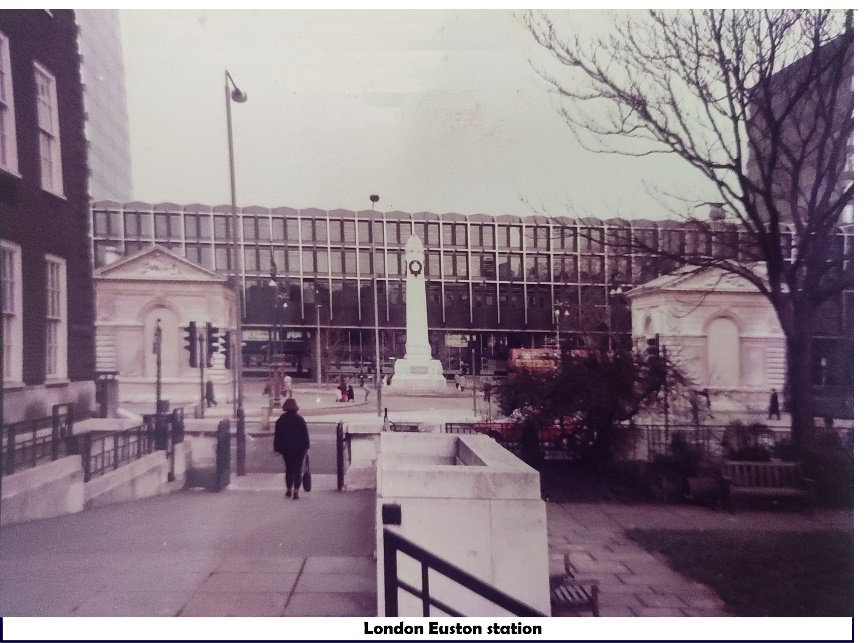
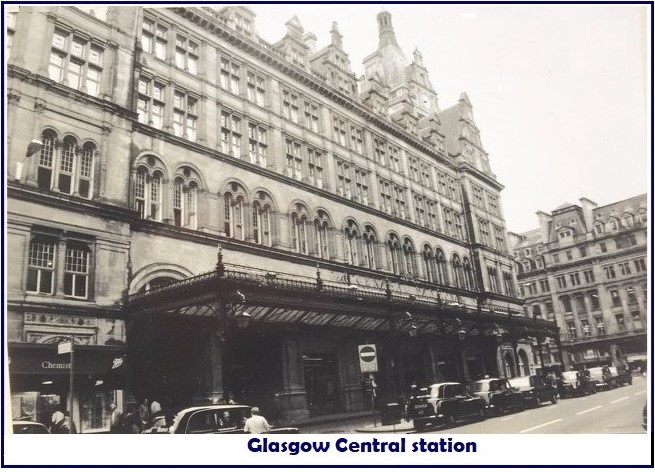
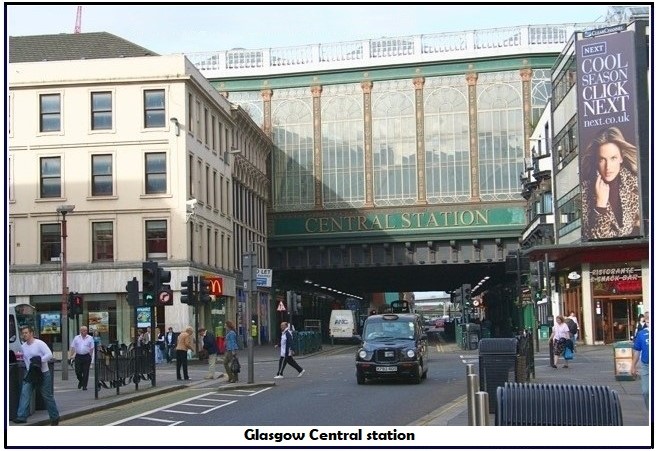
Edinburgh—Edinburgh Waverly is the second busiest station in Scotland after Glasgow Central. The station building is a very tall & ornamental monument .The city (pronounced as Edinborough or Edinbara) is full of attractions. Scots Monument near in the memory of Sir Walter Scot. The. Calton Hill contains monuments of the distinguished individuals & offers a panoramic view of this visually exciting city. The imposing building of the Edinburg Castle is still occupied as barracks for the British army.
Glasgow-- It was the headquarters of the erstwhile Caledonian railway. Glasgow Central is the busiest station in Scotland and northernmost terminus of the WCML. The historic station building is stunning. We were accommodated in the Queen’s hotel located in the station building itself. The hotel forms the front of the station. Like the Midland hotel, Derby the Queen’s hotel at Glasgow Central too was once owned and managed by the B.R. but privatised recently.
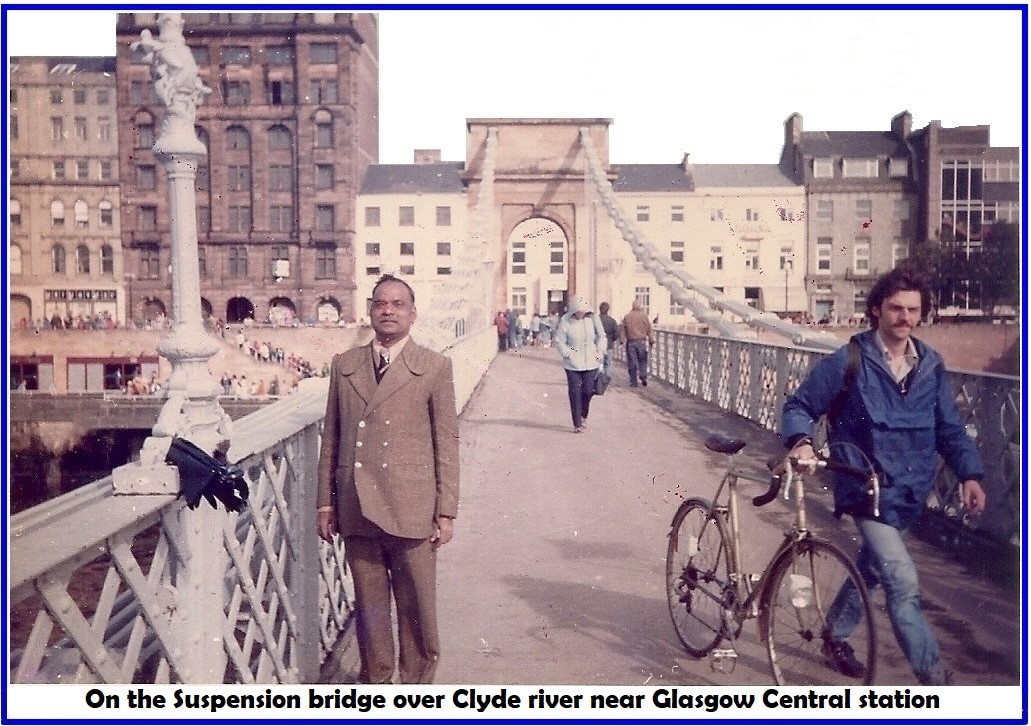
On the day of departure while strolling through the streets I came across the city Marathon Rally. Policemen were guarding major road intersections directing the traffic. Men and women wearing colourful dresses were running with great enthusiasm with no indication of competing with each other. Invalids on wheelchairs or sticking to crutches and children riding skates were also conspicuous. The crowds lining the streets cheered them profusely with words like- “you are near home, Sir”. They also offered water filled in plastic canes which the runners, poured over their heads. I had first glimpse of the Rally at about 8’o Clock in the morning in the heart of the city and watch it for sometimes standing from the cable suspension bridge on the Clyde river. Till my train left Glasgow station about 10 a.m. the rally showed no sign of abatement. In the shopping area I found some shop owners deploying gorgeously dressed persons playing Scottish bagpipes to attract the customers.
The return journey to London King’s Cross was via the East Coast Main Line (ECML) touching New Castle and York. This route known in the past as London & North Eastern Railway (LNER) is remembered for its prestigious ‘Flying Scotsman’.
The British Rail (B.R.)
The B.R. had attained its sublime heights during 1930 when it had about 20,000 route miles of track and about 5 lakhs staff. With the successive closure of uneconomic branch lines and progressive mechanization today the Railway lines account only for about 10,000 miles and the staff strength number below two lakhs. The rail network is expected to shrink further as also the manpower.
-
The Logo:- The British Rail Stations officers, staff, rolling stock and road vehicles are better remembered by the impressive logo they display. It is a pair of parallel arrows pointing in opposite directors with the intermediate arms overlapping with each other. It is normally white but also appears in red & blue colour.
-
Coaches:- There are only two classes of accommodation on the BR. Second class coaches which have no indication on the outside about the class. They have blue seat cover. First class coaches have I indication on the doors. The seat cover is red. They have additional facility of red tables in between adjacent rows of seats and cushioned headrest. There are two columns of seats on one side of the aisle and one column on the other side. The coaches are painted blue and cream from outside. Restaurant buffet cars are more attractive looking with red and white paint. All the coaches are designed for sitting arrangement only except for. ‘Intercity Sleeper 125’ trains which exclusively provide sleeping accommodation on overnight journeys between far-off places. The slam type main doors open outward but that present no problem. They are intended to provide the safeguard that all the passengers are well inside before the train could move. They, however, cannot be opened from inside. The shutter at the door is required to be pulled down and the hand taken outside to operate the handle before a passenger can think of opening the door. But on most of the occasions it is an entraining passenger who opens the door from outside.
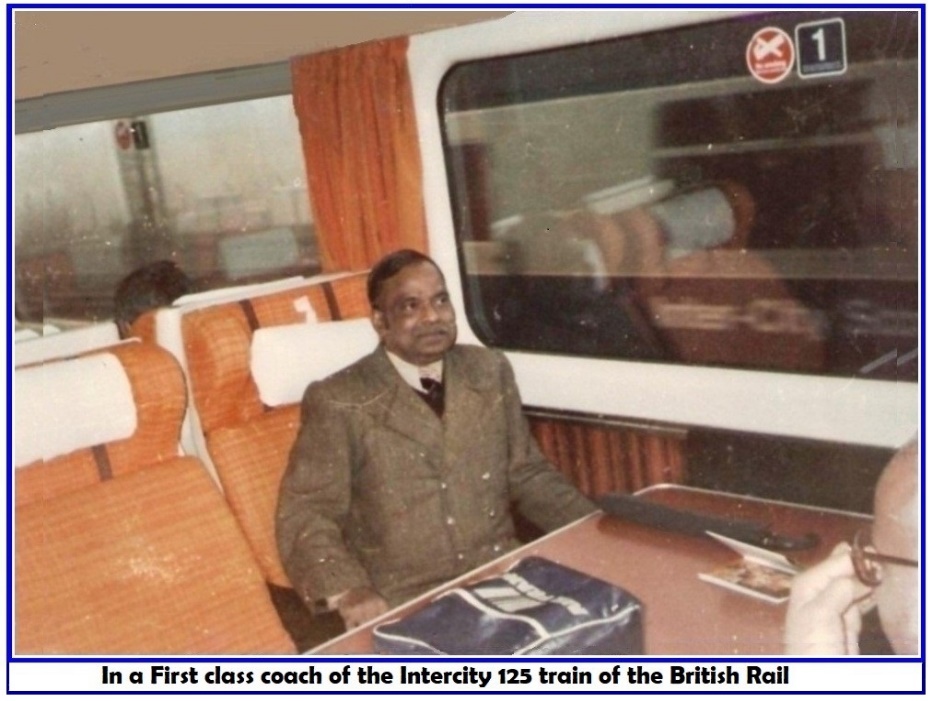
. Photo-cells actuated sliding doors exist at the two ends which come to open position at the sight of an approaching person. When there is nobody in the range of the cells, they keep the doors closed. There are separate smoking and non-smoking compartments. Soaps are provided in the toilet which also has hot water supply. Commodes have water seal & flushing cistern. The entire train is vestibuled and centrally heated. One unfamiliar thing is a hammer provided in a glass case to be used for breaking window panes during emergency. There is a small luggage compartment at one end of the coach. Only small handy luggage is carried in the compartment to be kept below the seats or on overhead rack. Curtains are provided on the inside of the large size windows which can be moved to one side to allow unrestricted view of the landscape from the moving trains. Boys playing football in a slushy field ,countryside with modest looking villas, farmstead equipped with sprinkle system of irrigation, Friesians & Herefords chewing a drowsy cud in the meadows and barely able to keep their milk pouch above the ground ,towns in the shadow of ancient masterpiece , the unserviceable cars stripped of non-ferrous parts & pressed to sheets in the scrap yard, serene cemeteries visited by near & dear ones of the departed souls, the sublime churches & cathedrals compelling attention, the moorland are some of the common sights doling out enjoyment as well as enlightenment.
-
Traction:- With the solitary exception of Severn Valley Railway which is run for remembrance sake no steam loco is seen on the B.R. After decades of active service, a number of them are leading retired life in the NRM at York.
-
Intercity 125:- It is essentially a marketing/descriptive term to cover the high-speed train sets, which are capable of attainting 125 mph speeds.

The push-pull train sets consist of a power car at each end and a rake of carriages in between. The sets stay together as units but can be broken up and remarshalled if servicing for instance is necessary. The Power cars were named after a person place or an institution such as ‘Sir Francis Drake’ ‘The city of Birmingham’ & ‘University of Bradford’ etc. Intercity 125 are very popular for business travel.
-
Railway station:- Important stations have terminus character with large sheds spanning all the platforms & lines .‘Regency Buffet’, ‘Travellers Fare’, ‘W.H. Smith’, ‘Macdonald Hamburger’ stalls sell magazines, eatables & stationeries. Electronic indicator boards show the time of departure & composition of the train to leave next in respect of individual platform. Indication regarding departure time of the next train also appears at the entrance gate of the platform. Entry to the platform is regulated and the gate opens only when the train is serviced and ready.
-
Left-luggage:- The charge is 50 pence for every item.
-
Lockers:- They are provided at selected stations. But there was temporary withdrawal of this facility because of few incidents of explosion.
-
Coolies, hawkers, & beggars are conspicuous by their absence.
-
Public address system:- A melodious ringing sound marks the beginning of an announcement, which is bereft of words like. ‘May I have your attention please?’ ‘reported’ and ‘expected’ etc. The terse announcement goes like this ‘the next train on platform 3 is 10.30 train for London St. Pancras calling at Sheffield, Derby & Leicester’. The Relief trains supplement the existing service during rush hours. Those coming to station to receive arriving strangers, stand at the exit with a placard displaying name. Staff on duty keeps communicating with each other with the help of walkie-talkie and their attention is not required to be drawn on the public address system.
-
The station porters:- Their duty is to close the outward opening slam doors in case the entraining and detraining passengers have left them in open position, blow whistle to attract the attention of the guard and wave at him in token of doors having been closed.
-
The guard:- On receipt of clearance from the station porters, the guard signals the driver to start the train by ringing bells. At the start of the journey he gives description of the train, welcomes the passengers and makes announcement about the approach of the stopping stations as well as opening/closing hours of the restaurant buffet service. He invariably apologizes to the passengers in case the train is running late. When the train is on run he examines the tickets of the passengers and returns them with thanks. In India we were accustomed to disposing off the ticket checkers by announcing Pass but the ticket checker on the BR insisted on physical verification.
-
Tickets:- Only computer printed paper tickets are issued. The booking windows have a revolving disc in which the customer puts the coins/notes specifying the journey and the class. The booking clerk rotates the disc to get the coins/ notes to his side. After putting the ticket & the change he rotates the disc for the second time to allow its content to be picked by the customer. At some stations credit cards are accepted for issuing tickets for selected destinations. Facilities also exist for on-line purchase of tickets from the computer installed in the station premises. On branch line trains booking facility normally does not exist. People are expected to entrain from the side of guard’s cab and purchase ticket. However, after the train moves the guard checks the passengers & tissue tickets to those who need them. On certain trains second class ticket holders are permitted to travel in the first class on payment of one pound extra only. First class compartments where smoking intending passengers must seat are specified by pasting appropriate notice on the window panes:
Penalty:-The following penalties have been stipulated:
(a) For smoking in a non-smoking compartment---50 Pounds
(b) For unauthorized pulling of alarm chain---------50 Pounds
(c) For travelling without a valid ticket ---------------250 Pounds and/or 3months jail. Remodelling of stations:- Many of the stations were designed about hundred years back to handle a certain level of traffic which has now dwindled. Keeping the erstwhile platforms & yard lines, therefore, does not make much sense. The stations are remodelled so as to reduce the number of platform lines, simplifying the layout to run through lines only by eliminating points & crossings and doing away with the cabins. When I was taken to see the functioning of hydraulic retarders at the erstwhile busy marshalling yard of Tinsley near Sheffield, I was sorry to learn that the yard was on the verge of closure. At Preston station one advertisement appeared announcing proposed reduction in number of points & crossings from 600 to 250. At London Broadway street the yard lines have been removed to make car parking space. At Paddington (London) and Marylebone (London) a couple of dock platform lines have been dismantled and space thus released utilized for car parking. People are encouraged to come to station, park the car and undertake train journey.
-
Ticket checking at station:- With assured system of checking of tickets in the train, checking at station is gradually being dispensed with. When I had arrived Derby, the ticket checking at the gate was in vogue but after a month I found it withdrawn. The ticket collector sits in a glass cabin at the entry of the platform and carefully scrutinizes all the tickets, which often results in formation of long queue. Nobody defies ticket collector’s authority to force an entry or exit because he happens to be inside an enclosure
-
Train spotting- The country has railway enthusiasts whose pastime is to collect identification numbers of locomotives, coaches, and wagons, noting the date, time and place where they were seen and often where coming from and going to. This hobby, termed as train spotting, appears harmless but at certain locations it is forbidden for reasons of safety. Train spotters are forever being ridiculed as no purpose appears in this peculiar pastime. Few non-practitioners have been able to find an answer to that.
-
The Flying Scotsman:- The East Coast main line (ECML) route is proudly remembered for this celebrated train of the London & North Eastern Railways (LNER) which moved uninterrupted between 1862 and 1982 ,leaving London (King’s Cross) at 10’0 Clock for its 392.7 miles long journey to Edinburgh Waverley, during which period the journey time was progressively reduced from ten & a half hours with stoppages at Grantham, York and New Castle to five & a half hours non- stop. The non-stop journey for such a long-distance during steam traction days was made possible by introduction of specially designed steam locomotives with an 18-inch corridor tender vestibuled to the leading coach to enable the driver and the fireman to be changed during the journey without any stoppage.
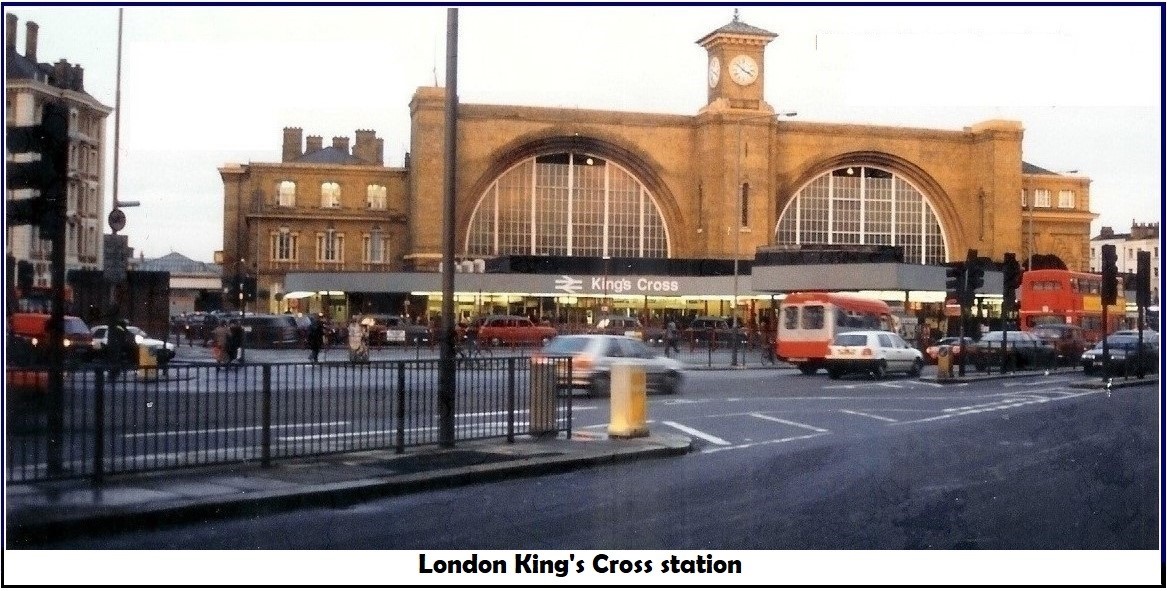
The water was picked up by the running locomotives from the troughs (9600 yards long 18” wide and 6” deep) provided en route, by means of scoop capable of being lowered and raised from the locomotive.

Journey to France
Concession pass--We had already obtained ‘Billet avec reduction 50 % pour un seul voyage’ (concession pass) from the SNCF.

Visa:- During my short stay at Delhi prior to departure for London, I could not get visa from the French embassy and I decided to try it from the Ambasse de France en Grande Bretagne, Londres
 (French embassy in London) located at Knightsbridge on the southeast of the Hyde Park. There was no signboard on the building and the policemen guarding it only confirmed to me that it was the place I was looking for. I had brought with me courtesy letter from the Indian high commission in London, which I deposited with the embassy staff along with my passport. Since it was a common letter in favour of 18 officers, I requested him to return the same for use by other officers also. He was kind enough to prepare a photocopy of the letter and hand it over to me. When I went to the Embassy again the next day, I was handed over my passport with ‘Plessieurs entrée visa de service’ (Multiple entry visa) duly endorsed thereon. I complimented the staff in French ‘Merci beacoup monsieur’ (thank you very much, sir) and he returned it by folding his hands.
London to Paris - Our first attempt to cross the English Channel was destined to failure. Due to rough sea the train from London Victoria was taken to Dover Eastern Dock against scheduled destination of Dover Western Dock. After waiting for three midnight hours in gruelling cold to be allowed to board the ship we abandoned the idea of crossing the channel. The night had not receded, and the roads were deserted when we had to walk for about couple of kilometres taking cue from the signposts to reach Dover Western Dock Station for catching train for Victoria. It was a wasted trip for which we were to blame for ignoring television news warning. On another weekend in the same company, I commenced my journey. Exchanging pound sterling for Franc was a facile job as “Bureau de change” provides this facility at a number of places charging nominal commission.
We took a Northern line underground train at Euston to arrive Victoria at about 8 P.M. This is a busy terminus station of the southern Rly with 14 platforms. The electronic indicator board showed the departure timing of the Paris Express as 21.15. There was long queue at the entrance gate of Platform No-2 because in the B.R. the passengers are not allowed to enter the platform unless the train is serviced and ready and the tickets have been examined. We were occupying a first-class compartment in which one French was also seated with a second-class ticket. The ticket checker asked him to pay the difference or else occupy a second-class seat. The French drew blank to English language but when the ticket checker repeated his words using ‘premier’ for the first and ‘deuxeume’ for the second class, the gentleman came to sense and changed over.
The English Channel and the sealink:- We reached ‘Dover Western Dock’ station in about 2 hours. After getting down from the train we had to pass through a long corridor covered on all sides to board the ship ‘Sealink’. As we entered the ship we were asked to keep our baggage on racks at one corner. Only small handy bags were permitted to be carried with us. We were comfortable in our chairs. The English Channel was placid. There was a duty-free shop in the ship selling wine, cigarettes and perfumes and a restaurant serving food and drink. The ship also ferried railway wagons, containers as well as cars. We reached the port of Dunkerque at about 2 A.M. The French standard time is one hour in advance of British standard time. There was no difficulty in retrieving the luggage although they were all kept on racks at owner’s risk. When after immigration check we came across the ‘Douane’ (customs) on the Red channel (signifying ‘goods to declare’) and the Green channel (signifying ‘nothing to declare’) there were elaborate instructions about the excepted articles and the limiting values of accepted articles such as wine (1 litre), cigarettes (200 nos)., perfume (50 gms) etc. As we made our way through the Green Channel we were ignored and after winding our way through a long corridor similar to that at Dover we came to Dunkerque Maritime station where the SNCF train was waiting for us.
Societe Nationale des Chemins de Fer François (SNCF) stands for French Railways - ‘Chemins de Fer’ means ‘Railroad’. The train left Dunkerque Maritime at 5 A.M. There was a little misunderstanding when the ticket examiner wanted to issue a first class ticket to us as per indication in the ‘billet Avec Reduction de 50%.’ But since we intended to conserve money, we opted for second class paying 50% of the fair amounting to 54 Francs to cover journey up to Paris Gare du Nord. As the morning drew the waiter entered the coach with snack trolley &the passengers addressed him as Monsieur (sir). The train arrived Paris Gare du Nord (north station) at 9 A.M. It is one of the 7 railway termini in Paris. The station is served by the trains running between Paris and northern France via the Paris-Lille railway as well as to international destinations in Belgium, Germany, Netherlands and United Kingdom. It offers connections with urban transport viz Paris Metro, RER and buses.

No less extravagant than St. Pancras or Paddington, but built on functional lines, is the wide frontage of this station. It is the busiest railway station in Europe by total passenger numbers.
Hotel:- We approached the tourist Office located in the station building where list of all hotels classified as ‘one star’; ‘two stars’ etc. in accordance with the locations and facilities available were kept. Once the limit of expenditure was specified by us the enquiry clerk located a suitable hotel from the list, established contact on telephone and arranged booking on the spot realizing a small sum as service charge. As we were coming out of the station, we were shocked as we found ourselves mobbed by a group of young boys and girls trying to lay their hands on our pockets. We immediately prepared ourselves and raised our arms in retaliation. The result was quick, and they all fled away. The hotel where we were accommodated for a charge of 150 Francs a day was reasonably comfortable.
Metro:- From Paris Gare Du Nord metro Station we purchased ‘Paris Sesame’ which is a 51 Francs ticket valid for two days for unlimited travel on the network operated by RATP: Metro & RER in first class carriage and road services. A magnetic card was also supplied with the ticket for insertion in the slot of the electronic gate to make it open. The city’s underground railway is often overground too. One of the most efficient and attractive, systems of its kind in the world, the metro provides the fastest, cheapest and least strenuous way of getting round the city. A train arrives approximately every two minutes. Blue coloured Metro cars are quite silent, running on rubber tyred wheels. Location of a metro station is indicated by a board bearing the word ‘Metropolitan’ erected at the entrance of the subway. Different lines are indicated by the names of the departure & terminus stations and the names of the intermediate stations are displayed at the platform entrances. In each coach one finds the complete itinerary of the line. Each has its specific colour on the map-meet at certain intersections where one can change from one line to another on following the instructions under the ‘Correspondence’ sign on the platform. Each metro platform is assigned to one line only. ‘Sortir’ boards indicate exit points. The stations are assigned names such as Voltaire, Anatole France, Danube, Kremlin, Luxembourg, Pyramids, Rome etc. Colourful fibre glass chairs have been provided on the platforms. The Metro exemplifies much of what Paris is about; beautiful, efficient and moving with the time. The stations are not merely clean; each is distinctive. many are downright attractive but not prepared to surrender beauty to expedience. Louvre is so lavish that one feels the train has actually arrived inside the museum. It is a trait that running throughout her history, has made Paris what she is today; beautiful, unique- one of the greatest cities of the world
The romance of Paris (pronounced ‘Pari’ in French)
It is difficult to believe that in the world there is a city as beautiful and interesting as Paris. Whether one is French or a stranger, an artist or a scholar, a workman, a tourist or simply a student, Paris offers incomparable charms to all the visitors whoever he is. If a stranger wants to know Paris well, he should walk on foot, no matter in what direction. This is a city where one can loiter for the whole day without getting bored or tired.
The Seine:- The River is of incomparable importance to the city. Not only does it provide Paris with so much of her character, beauty & grace, it is largely responsible for the city’s very existence. For it is here on the island of Ile de la cite (Island of the city) that it all began about 2000 year ago. The boat-shaped island is the cradle of Paris. Being here one gets the feeling that it is almost the island which moves, not the river. The Seine flows clean through the city in a long majestic loop for some 13 kms and divides it into two almost equal parts, the Rive Droite (right bank) and the Rive Gauche (left bank). Very much an inland river and too far from the sea the seine is slow-flowing and a little wider than the great Parisian avenues. The river is crossed in Paris by many bridges. Pont Alexander-III with its gilded statues and ornate lamps is very attractive and getting photographed leaning against the bridge parapet was a delight. Parisians have always made the most of the Seine. Along its banks they rest, stroll and meditate. Lovers find an idyllic rendezvous (meeting place), fishermen idle away the hours. Seine refreshes and renews the great city. It is the balm and one of the greatest joys of Paris.
Eiffel Tower:- It is the most famous landmark of the great city. One could not possibly visit Paris without seeing it. Even if one does not want to visit this world famous structure, he/she will see its top all over Paris. We came out of ‘Trocadero’ underground station. Down the terrace of Trocadero is the Seine with the Eiffel Tower standing majestically on the other side. The symmetrical layout of the ‘Champ de Mars’ beyond the tower leads to the Ecole Militaire (where Napolean studied). Rising behind this ancient masterpiece is the modern UNESCO building. In the vicinity of Eiffel tower Negroes were selling models of the tower & plastic crows, sometimes being chased away by the police.
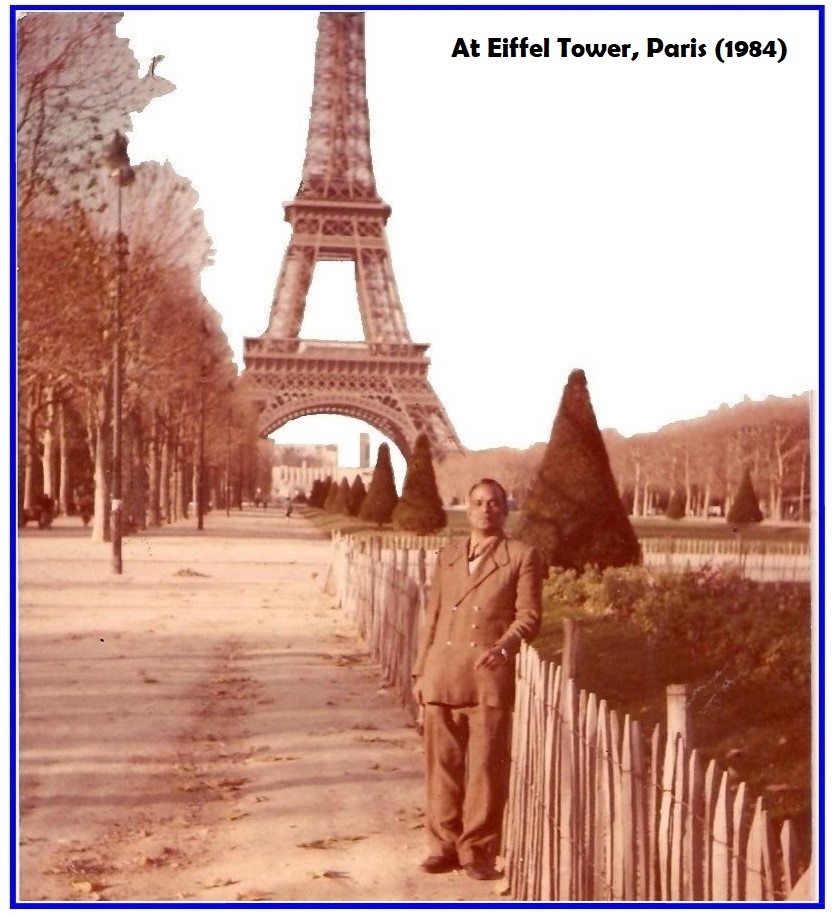
Versailles Chateau:- (‘Chateau’ means palace). It is located 23 km southwest of Paris. We approached it by the bus no. 171 from the Metro station ‘Pont De Serves’. One of the wonders of France built in pink & cream stone Versailles has to be experienced to be believed. Originally a modest hunting lodge Louis XIV moved his court here from Louvre, transforming it into a vast & splendid palace with heroic sized statues & sumptuous state apartments. With a long facade, lavish stuccos, frescoes & tapestries it presents a vision of opulence & splendour that is stunning to the modern mind.
Louvre:- Every stone in Paris is steeped in the past and the events of her long and mighty history pervades through every boulevard and street corner, through a column, a monument or an arch. Paris is a city of visible, living antiquity. And of all Paris buildings none is more representative than the incredible Palais Du Louvre (Louvre Palace). Though never it has held more wealth, today it is one of the largest, most richly endowed museums in the world, containing some of the highly prized paintings and sculptures. Famous original painting of Mona Lisa displayed here did not impress me. It was tiring to go through the galleries of the museum.

Notre Dame:- I was attracted to it as a school of the same name exists at Patna but it is actually one of the oldest & the most beautiful cathedral of Paris located on the island in the middle of Seine. French are proud of their language. Even it is so they have reasons for it as the language has international recognition and of great literary value. To get their attention while in Paris one should not be shy of using the words ‘Bon jour’ (good morning), ‘Bon soir’ (good evening), merci (thank you) and ‘Sil vous plait’ (please). Such a courtesy is looked for by them. While trying to find out the location of Notre Dame I greeted a French using above words and asked for guidance in broken French. He was highly pleased and asked me in French if I knew English.
Arch de Triomphe:- It is the tomb of the unknown soldiers, with its eternal flame. Located at end of Champ Elysees. it is a large circular square from which twelve avenues emanate in a star pattern. ‘Etoile’ means star & hence the name of the adjacent Metro station. A fine view of Paris can be had from this triumphal Arch.
Bastille:- Instead of a prison we found a commemorative column, made of segments of cast bronze, stood in the centre of the Square where Bastille Prison stood until stormed and demolished in 1890. It was surmounted by a gilded globe on which stood a colossal gilded figure.
Markets:-Famous markets:- Marche aux Fleurs – Flower market-‘Fleur’ means flower
Marche aux Oiseaux – Birds market-‘Oiseuax means bird’s shops.
Boulangerie (Bread shop):- It calls with its fresh – bake smell and appetizing stacks of long loaves.
Patisserie (cake shop):- It sells cake & pastries but no bread.
Tobacconist:– The shop is indicated by a red carrot outside. Items for sell include cigarettes,
matches, stamps, inexpensive watches & souvenirs. Letter box painted yellow can be seen
fixed to the wall close to a tobacconist.
Pharmacies:- the shop is indicated by a big green cross lighted when open.
I was amused to find that both ‘Leau minerale’ (mineral water) and ‘le lait froid’ (cold milk) cost about 6 francs a litre. The menu displayed outside restaurant has both an economical ‘Prix fixe’ (fixed price) and an expensive ‘a la carte’. In one departmental store I found a novel way of selling fruits I collected oranges in a polythene bag and placed on an electronic balance displaying the picture of different fruits on push buttons. After the one displaying orange was pressed a slip came out showing the rate of the fruit, the weight and the cost. I walked to the counter with the slip for payment.
Sidewalk Café:- It is one of the greatest charm of the city with an atmosphere of Joie de vivre (Joy of life). The French spend much of their time here discussing, dreaming & regarding others Some of the renowned & elegant street cafes are located on the majestic I’ avenue des Champ Elysse.
Parks & gardens:- In Paris the great parks with their gardens, lakes ,woodlands, waterfalls, trees, lawns, geometric flower beds and statues are examples of ordered beauty, tranquillity, elegance & provide a feeling of being in the countryside itself. Le Jardin des Tuileries (The tiles garden) featuring mythological statues, fountains, basins & museums and Le jardin du Luxembourg are very beautiful places, one can imagine.
Traffic:-Vehicle and pedestrians keep on the right side of the road. The vehicle headlight consists of yellow anti fog lamps.
Return journey from Paris to London:- After vacating the hotel I came to Paris Gare du Nord (North station) and had to wait in the sale d’ attente (waiting room) for sometimes in an ambience hardly different from that of an IR station. I boarded London express in the evening hour for my return journey. The platform presented a scene of exchange of following pleasantries between the travellers and the onlookers:-
Au Revoir (Good bye) A bientot -(See you again)
After enjoying the French hospitality for 2 days I returned to Derby.
The closing days of our stay at Derby:- The UK training was a highlight of my career, offering insightful lessons with classical British courtesy. The expert faculty and interactive sessions made the training truly enriching. The opportunity to network with professionals from diverse background was invaluable. The British culture and way of life were fascinating to experience firsthand. Unlimited travel over whole of the Great Britain in the ambience of First class of the British rail, comfortable stay either at the ‘India House’ hostel of the BRES or at any hotel of the country, substantial allowances, and the British hospitality had overwhelmed us. It was a truly memorable stay.
We were not entitled for National Health Scheme funded treatment except for accidents and emergency. But the British Council had arranged for a doctor (an Indian) at Derby, who happened to live near the BRES, for consultation in case of sickness. Fortunately for us such a situation never arose in our batch. We had all returned from our Attachment training and shared our experience. The purchases made and the places visited were discussed to ascertain if any inevitable has been missed. Money was never a problem in acquiring garments, perfumes, cameras, souvenirs etc. What was worrying us was the limitation put on weight of baggage in the aircraft (20 kg. in luggage compartment and 5 kg. in cabin). Naturally the reading materials found their place in the litter bins. Still, we made assessment of the weight of our belongings and came to understanding amongst ourselves for an equitable distribution of the articles so as not to be involved in payment for exceeding the limit. Also, the value of the purchases made was to be within Rs.1250/- to escape customs duty. Mihir Dev Verma (called the tip of the iceberg) suggested the following measures to outwit the customs at Delhi:
The SLR camera instead of being hidden in the suitcase should be boldly displayed by hanging from the shoulder.
Silly things like electrical goods, eatables, and petty items of souvenirs should be carried in the handbag. Sarees should be handed over to Rukmini (the lady member of the batch).
Many ‘bureau de change’ at London were offering Rs. 16 for one pound (against the official exchange value of Rs. 15). But the ‘tip of the iceberg’ advised us against such a transaction on the ground that bringing rupee currency in India from a foreign land constituted an offence.
The concluding session on 06.12.1984:- On this occasion our course leader-Sri Venkatraman - while speaking high of the affable British people and the usefulness of the course, could not help observing that at some occasions there were reasons for us to feel slighted. He cited the following examples to justify his point:
If an Indian happened to approach a wrong enquiry counter, he would be given a cold shoulder and not guided correctly.
No apology will forth come from a British for making us wait beyond the appointed time while we were under great pressure to be all the while punctual to the second.
Our hosts appreciated these frank comments and accepted them gracefully.
The farewell dinner:- In the evening we were accorded buffet dinner by the school in the lounge. After dinner we assembled in the room of our course leader for celebrating our last night at Derby in a ‘free-for-all’ manner. We hardly had a sleep of a few hours in the night.
The parting breakfast:- It was early morning of 07.12.1984 that we went to the dining hall for an out-of-schedule breakfast. In absence of waitresses, we helped ourselves with cornflakes, milk, bread, cheese etc. kept on the table. We parted with the leftover items of souvenir brought from India in favour of whosever from the school was available. It was the time for us to bid goodbye to our loving school and the amiable Dag who pulled his bus along the portico for our journey to Derby station. I felt reflective thinking about leaving behind the familiar and gratitude for what I learned. The inscription STET FORTUNA DOMUS on the main entrance receded as the bus emerging from the driveway of the school campus joined the stream of traffic on the London Road. It drove past DIY Supercentre, Royal Mail, Willmortan Post Office. Swap Shop, DHSS and the Midland Hotel before coming to Derby Station where the 09.00 hrs Intercity 125 was waiting to take us to London St. Pancras .
Derby to London - The train arrived St. Pancras at 10.30 hrs. After depositing my belonging at the left-luggage room of the station @ 50 pence each I proceeded to Oxford Street underground station for taking delivery of the photographs. The shopkeeper had made the arrangement of receiving film roll in absence for which a pack of serially numbered envelopes were kept on the outside. The film roll could be put inside the envelope, retaining the counterfoil, and dropped in the door slot. The photographs were developed along with comments. I hurried back to Euston station for attending lunch in the British Rail Board (Rail House) with the Engineer Member. In the get-together there was an informal exchange of views on the working of the two railway systems and the usefulness of the training. ‘Whether the British rail receives Subsidy/grants from the Govt. or not’ was a subject of debate between us and the Course Director-Principal during the course. Allen made use of this occasion to pose the issue to the Board Member. The moment was made memorable by informal photography. Lunch followed. When after finishing my meal, I was looking for a suitable place to deposit my plate one lady approached me and requested me to part with my plate. It was an act of great courtesy.
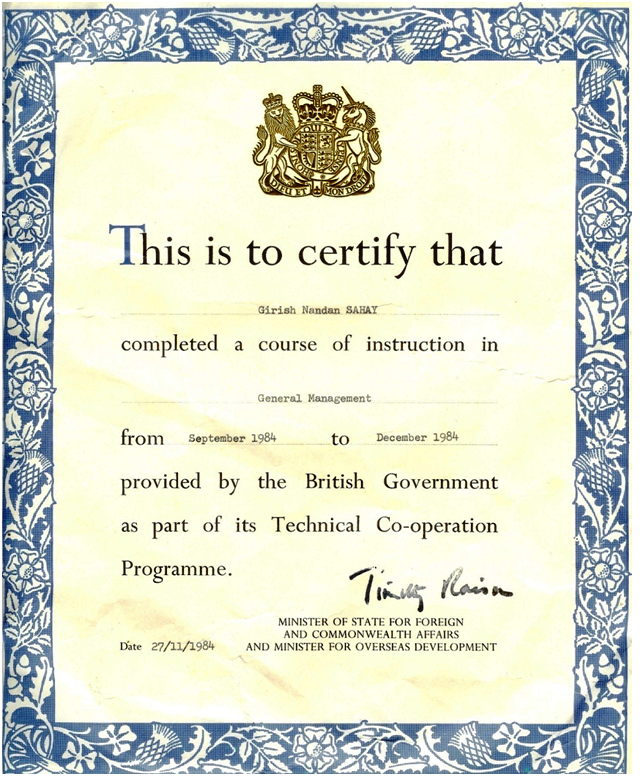 At this stage certificates granted by the Minister of State for foreign and Commonwealth affairs, ‘in token of our having completed a course of instructions in General Management”, were issued to us. In the Board office I discovered that only the most senior officers had name plates and these were usually on their secretary’s doors. Allen Ewers who took such elaborate care of us at every stage and endeared himself to us, took leave of us. The next engagement
was at the British Council at the Spring Garden near Trafalgar Square where we had been on our first day of arrival to receive arrival and other allowances. This time it was the turn to receive departure allowance after depositing the feedback Performa (no signature demanded) on the usefulness/shortcomings of the course and the boarding/lodging arrangement at the BRES, Derby.
The last-minute marketing at London:- I deposited my hand bag in the hotel and decided to walk from Bayswater to London Paddington station and further onwards to the Edgeware Road. I made a hurried check of the items I must purchase and that provided scope of spending another 20 pounds on a sleeping gown, pencil sharpener and pens. The weather was very chilly and after every half an hour I entered a departmental store to capture the warmth of a centrally heated system. After having a last glimpse of the Marble Arch near one corner of the Hyde Park I decided to call it a day mostly because of unbearable cold. With the British Rail free card pass available I took an Inter City 125 ride to Plymouth from London Paddington and soon caught another train to return back to London. The aim was to keep myself warm for about 5 hours. Last stay at the Westminster hotel:- Back at London St. Pancras station I recovered my hand bag and had a last look at the elegant station building. I found out some time to take leave of my friend Mantreshwar Jha still staying at the CORA hotel. We exchanged some pleasantries over a cup of tea before parting. In fact, his training at the Royal Institute of Public Administration was to last for another fortnight and he too was to soon follow the suit. The British Council had arranged for our stay in the same hotel (Westminster hotel) where we were accommodated on our first day of arrival in London from New Delhi. Another film roll was ready to be processed and to my relief I discovered a shop near Bayswater which would deliver the processed film in 24 hrs. at a little extra cost. The day of hectic activities was over and it was time to relax in the cosy bed of the Westminster hotel and watch Television programme. 08.12.1984-The last Continental breakfast having been taken it was time for us to check out. Many of us had longed to fly to homeland on 8.12.84 itself by the 16.30 non –stop flight to New Delhi. That would have spared us from the ordeal of searching hotel for the night stay. It had also the added advantage, in that passengers arriving by this flight were not subjected to rigorous check by the customs because it did not touch gulf countries notorious for smuggling and bringing objectionable electronic goods. But there was no room in it and we were booked by the 10.30 flight on the following day. The day was very short, and darkness descended at 16.30 hours. Back to Bayswater I did not forget to recall the old acquaintances viz the grocer shop and the telephone booth on the Moscow Road. I took delivery of the film I had given for processing earlier and walked to the Westminster hotel to get back my hand bag. This was the beginning of my last lap of journey.
Westminster hotel to Heathrow Airport - Three of us had decided to reach London Heathrow Airport on the night of 08.12.84 itself as the check-in time was 08.30 hrs. and the Airport was quite far from the Westminster hotel where we were putting up. My friends arrived from Derby at the appointed time at London St. Pancras station and I too was there in time with my luggage retrieved from the left luggage room. A little confusion arose here as the ticket checker at the entrance professing to examine my 1.5 pound ticket inadvertently put it in his ticket tube instead of returning to me. Soon he realised his mistake and with great difficulty fished out my ticket from the lot. We boarded the last Piccadilly line train for our journey to Heathrow airport. Similar difficulty as witnessed at St. Pancras station arose at Heathrow also in having required to move the luggage up the escalator without the help of a luggage trolley. Up on the ground level we were relieved to find luggage trolley kept in nice array. A very long travelite with railings on both sides was continuously moving, carrying people with luggage trolley to the exit end. All young, old and children were easily stepping over it with their luggage trolley and going.
09.12.1984 (London to Delhi ) -We waited in the Airport lounge, made a last moment reshuffling of the content of different bags/suitcases discarding brochures, leaflets, cartons and items of stationary, hitherto considered necessary for retention. Early morning, we were ready and in time at the check-in counter of the BA 147. There was a little amusement when the counter clerk was seen not paying any heed to the 20 kg limitation in weight of the suitcases with which our mind was so deeply exercised all these days. The suitcases were deposited on the conveyor belt and indication was given to the computer regarding my ‘Asian Vegetarian’ food habit. I was again obliged by being offered a non-smoking window seat number 27A. Immigration officials were very prompt in disposing tourist wanting to leave U.K. They only ensured that the authorised period of the stay had not been exceeded. With the suitcases and hand bags packed to the full I had to carry lot of things like scissors, blade packets fountain pens, etc. in the overcoat. These added to things like wristwatch, spectacles and belts caused appreciation indication of metallic objects. I had to empty the content of the overcoat and again pass through the electronic barrier to satisfy the security officials. When I approached Customs for endorsement on the VAT forms regarding goods to be carried, he insisted on showing the same as required under rules. On explaining that the value of goods was insignificant and that they had been despatched in the suitcases he was convinced and made necessary endorsement on the VAT form after affixing stamp. I had brought stamped addressed envelopes and enclosing the certified VAT forms dropped them in the letter box provided next to the Customs counter. I did not forget to post ‘Free Card Pass’ and ‘50% concessional card pass’ issued by the B.R. for which purpose stamped self-addressed envelopes were provided by the school. With enough of time in hand we waited at the departure lounge. It pleased me to hear announcement in Hindi regarding flights to India. There were a number of duty-free shops advertising sale of goods but that did not enthuse us as the things were proved almost at the same rates as applicable in London market. But to our worry ,the British Airways official re-examined the size and weight of our cabin baggage and insisted that oversized and overweighed ones should be deposited for transportation in the baggage compartment. The worried passengers were however relieved to learn that they would not be charged extra for it. Passage to the aircraft through the aerobridge was regulated and passengers having seat numbers within specified range only were admitted at a time. The aircraft disengaged itself from the terminal building at 10.30 hrs. and started moving towards the runway. When it took off from Heathrow, I gazed out of the window watching the city’s towering skyscrapers ,the intricate network of roads, green spaces and the iconic landmarks- the river Thames, the Bigben clock tower, the Parliament House, the Windsor castle slowly fade into the distance. It was surreal to have bird’s eye perspective on the urban grandeur and natural beauty of one of the world’s greatest cities. I could not have asked for a more fitting send-off from the vibrant city of London. Because of eastward movement the daylight was over while the watch showed about 15.00 hrs. GMT only. The aircraft was fully packed mostly with Arabs and Indians. The British and sari-clad Indian stewardesses were all smile to the passengers while serving food. The Indian stewardess would make announcement in Hindi & converse in Hindi with those who desired so. They even helped semi-literates in filling disembarkation card. The aircraft first landed at Kuwait and although it remained there for an hour we were not permitted to disembark. Dubai was the next stoppage where many passengers got down for a last moment purchase from duty free shops. However, for some of them it was the final destination, and their seats were taken over by new faces mostly by clumsy looking persons returning to India after making a fortune out of petrodollars. When the aircraft was close to Palam Airport the steward sprayed ozone stating that it was in compliance to the Indian regulation and that those unable to stand it could cover their eyes for sometimes.
10.12.1984 (Arrival at Delhi):- We were back in our homeland after being away from it for about 3 months. It was 23.30 hrs. of 9th December by BST but 04.30 hrs of 10th December by IST with coldness comparable to that of London. As I stepped off the plane I felt a deep sense of belonging and connection to my homeland. Complying with the health and immigration checks was easy but recovering luggage proved formidable task. Luggage arrived in belt conveyor in succession, kept revolving and dropping on the floor causing great scramble for searching one’s luggage. It took me about an hour to retrieve my suitcase . Finding no luggage trolley available. I was left with no more patience but to carry the luggage suspended from arms and walk towards customs barrier. While there were 6 rows of red channels with about 10 persons standing in each row awaiting clearance, the Green Channel was empty. A person who has no dutiable goods or values or goods not exceeding Rs. 1250, could walk through Green Channel unless stopped. Much however depended upon the interpretation of the customs regarding dutiable goods and value of the goods. According to my assessment I qualified to walk through Green Channel and made my way through it. But the Customs official stopped me to ask if I carried any sari, computer or two-in-one. Though replied in negative he insisted on having a look at the content of my suitcase. On seeing things of value well over the prescribed limit, his only comment was that I was carrying a lot of garments. His colleague, however, intervened to say that I was a white passport holder and need not be embarrassed. So, I was cleared and emerged from the customs barrier to discover to my great happiness that my wife and younger daughter accompanied by my sister and brother-in-law were there to receive me. They had almost given up hopes of my arriving by this flight until the brother-in-law verified from the list of passengers that I was one of them. But it was my daughter who painstakingly scanned all the incomers and spotted me as soon as I appeared on the scene. Two of my staff had also come at the airport. I rested for the day at ‘Mahanadi’ apartment of the JNU campus in the company of the family members & relatives and departed from Delhi for Danapur by Magadh Express in the evening hours.
11.12.1984 (Delhi to Danapur):- When the train arrived Ara station I found close relatives and the station staff waiting on the platform with sweets to greet me . They also wanted me to detrain. I was sorry to disappoint them. They had arduous wait for hours because of late running of the train. Finally, the journey came to an end with the train arriving Danapur.